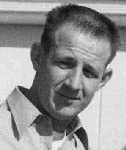
 "My unit, which was in the islands, was the 5th regimental combat team,
which was a stand alone unit, i.e., we were not with any division. We were
sent to Korea in June 1950. We arrived there on the 25th of June, at that
time our unit was sent into the Pusan perimeter and attached to the 24th
division.
"My unit, which was in the islands, was the 5th regimental combat team,
which was a stand alone unit, i.e., we were not with any division. We were
sent to Korea in June 1950. We arrived there on the 25th of June, at that
time our unit was sent into the Pusan perimeter and attached to the 24th
division. When the time came to break out of the perimeter, we were sent in to be the lead unit, so we were then attached to the 25th division. Men that were left of their 35th regiment came to our unit as replacements. So, there were three units that I was in while in Korea, 5th rct, 24th div and 25th div.
After the break-out fighting we went on to Seoul and by that time we had taken too many losses and were sent to the division rear. This was our first break in 3 months, at this time we got a bath and our first new clothes..." - Bob Brown
The 5th Regimental Combat Team, as a separate RCT, was assigned over the
course of the war to the majority of Divisions in the 8th Army. It fought
with the 1st Cavalry, 1st Provisional Marine Brigade, 3rd, 24th, 25th, 40th,
and 45th Infantry Divisions. Bob Brown recalls assignments with the 24th and
25th during his tour in Korea.
In the early days of the Korean War, the Army hastily began rebuilding the
5th Regimental Combat Team, gathering soldiers from different units on Oahu.
The 5th RCT became known as the "Hawaiian Regiment" during its Korea combat
tour because there were so many island kids in the unit. When the 5th
RCT finally sailed from Hawaii on July 25, 1950, there were 178 officers and
3,129 enlisted soldiers. The unit landed in Korea six days later.
One of the soldiers aboard was Retired Army Brigader General Irwin Cockett,
then just a 19-year-old private first class who volunteered for the Army
after graduating from Kamehameha School. "When we were alerted to go
overseas, the rumor was we were going to the Philippines to get organized
and get more reinforcements. It wasn't until we were at sea on our second
day when the C.O. (commanding officer) came on the public address system and
said we were going to Pusan."
Cockett said he can still remember groups of civilians lining Kamehameha
Highway in front of Schofield's main gate as the convoy rolled by. "I still
get chills thinking of all the families lined up behind a fenced-off portion
of the pier waving goodbye to loved ones."
Four troop transports -- the USNS Gen. Hugh Gaffey, the USNS Gen. W.A. Mann,
the USS Ventura and the USS Merrill -- were tied up at Army Pier 40 and
Pearl Harbor when trucks carrying Cockett and the rest of the 5th RCT
soldiers disembarked. As soldiers walked up the bow of the USS Mann, a Fort
Shafter Army band played "Now is the Hour."
Their arrival was a "baptism by fire," said Cockett. As they entered Masan,
battered troops greeted them with "don't go up there."
Their first night was lit with streaks of artillery fire, and within days
they had lost their entire artillery battalion and had to fight their way
out, taking only the walking wounded with them. The battle was called
"Bloody Gulch", in a conflict that has gone down in history as the
"forgotten war."
Few people know even today that the Territory of Hawaii suffered the
highest per capita casualty rate of any State or Territory during the Korean
War. From the time that The 5th RCT landed in Korea, 94.44% of the time,
they were actively engaged in combat.
The 5th RCT stands in the annals of military history among America's most
storied regiments such as the 442nd Go For Broke, 27th Wolfhounds and the
5th Marines.
from collected articles and reports.... Steve Brown
Casualties in Korea
The units listed below account for 96% of the Americans
killed by hostile action in Korea.
Wounded in action include only those actually hospitalized.
| Major U.S. Combat Unit | CASUALTIES | |
| KILLED IN ACTION |
WOUNDED IN ACTION |
|
| 2nd Infantry Division | 7,094 | 16,575 |
| 1st Marine Division | 4,004 | 25,864 |
| 7th Infantry Division | 3,905 | 10,858 |
| 1st Cavalry Division | 3,811 | 12,086 |
| 24th Infantry Division | 3,735 | 7,395 |
| 25th Infantry Division | 3,048 | 10,186 |
| 3rd Infantry Division | 2,160 | 7,939 |
| Far East Air Force/5th Air Force | 1,200 | 368 |
| 5th Regimental Combat Team | 867 | 3,188 |
| 45th Infantry Division | 834 | 3,170 |
| Naval Forces Far East/7th Fleet | 458 | 1,576 |
| 187th Airborne Regimental | ||
| Combat Team | 442 | 1,656 |
| 40th Infantry Division | 376 | 1,457 |
| 1st Marine Aircraft Wing | 258 | 174 |
| 1st Marine Aircraft Wing | 258 | 174 |
Source: Battle Casualties of the Army, 30 September 1954
(Office Assistant Chief of Staff, G-1, Dept. of the Army) and other
sources.
From the memorial dedication ceremony at Arlington:
Lt. Gen. (ret.) Richard F. Timmons:
"During the course of the war, the 5th would be attached to every U.S.
Division in the theatre including the 1st Marines. Many times when North
Koreans or Chinese made a hole in the lines, they'd call the 5th RCT to fill
the gap. They were the spearhead with the 1st Marine Brigade (P) out of the
Pusan Perimeter. When the Marines were moved back to go to Inchon, they
spearheaded the attack to Taejon."
"Getting the job done was not without a cost to the unit, though. According
to Timmons, the men of the 5th RCT suffered 867 killed in action, and 3,188
wounded, 16 missing in action, and 151 taken as prisoners of war. Some men
in the 5th RCT have as many as five Purple Hearts." He added.
"Yet, even during the worst of conditions, the men of the 5th RCT thought of
others. They financed, and built with the help of the 72nd Combat Engineers,
a Korean Boys Town. An orphanage that housed and supported war orphans, and
is still in operation, and supported by men of the 5th RCT today."
"There was great heroism in the unit too," according to Timmons. He said
"the 5th RCT earned three Korean Presidential Unit Citations, and two US
Presidential Unit Citations. Two members were awarded the Medal of Honor. 27
The Distinguished Service Cross' , 377 The Silver Star, 538 The Bronze Star
for valor, and over 4000 Purple Hearts, some men were awarded a Purple Heart
five different times. The regiment also was awarded ten battle stars for the
Korean Service Medal."
"From the torrid summer climate, 110 and above, to the bitter cold winters
-45 degrees, of that barren and treeless landscape, and always faced by a
dedicated enemy bent upon your destruction, the men of the regiment
prevailed and emerged as the premier fighting RCT of the conflict," Timmons
said.
"The dedication of this living memorial begins recognition of those valiant
soldiers who 48 years ago were truly key members of the defensive bulwark
that initially stood between a crushing battlefield defeat of the 8th U.S.
Army along the Pusan Perimeter, and the ultimate success on the Korean
Peninsular three years later. Time for recognition of this unit, is long
overdue."
CHAPTER XVI
The First American Counterattack -
Task Force Kean
What is necessary to be performed in the heat of action should constantly be practiced in the leisure of peace.
VEGETIUS, Military Institutions of the Romans
The enemy drive on Pusan from the west along the Chinju-Masan corridor compelled General Walker to concentrate there all the reinforcements then arriving in Korea. These included the 5th Regimental Combat Team and the list Provisional Marine Brigade-six battalions of infantry with supporting tanks and artillery. Eighth Army being stronger there than at any other part of the Pusan Perimeter, General Walker decided on a counterattack in this southernmost corridor of the Korean battlefront. It was to be the first American counterattack of the war.
The plan for a counterattack grew out of a number of factors-studies by the Planning Section, G-3, Eighth Army; the arrival of reinforcements; and intelligence that the North Koreans were massing north of Taegu. Although army intelligence in the first days of August seemed to veer toward the opinion that the enemy was shifting troops from the central to the southern front, perhaps as much as two divisions, it soon changed to the belief that the enemy was massing in the area above Taegu. [1]
The Army G-3 Planning Section at this time proposed two offensive actions in the near future. First, Eighth Army would mount an attack in the Masan-Chinju area between 5-10 August. Secondly, about the middle of the month, the army would strike in a general offensive through the same corridor, drive on west as far as Yosu, and there wheel north along the Sunch'on-Chonju-Nonsan axis toward the Kum River-the route of the N.K. 6th Division in reverse. This general offensive plan was based on the expected arrival of the ad Infantry Division and three tank battalions by 15 August. The planning study for the first attack stated that the counterattack force "should experience no difficulty in securing Chinju." [2]
[1] EUSAK WD, PIR 21, 2 Aug 50 and 23, 4 Aug 50.

[2] 2 EUSAK WD, 4 Aug 50, Stf Study, G-3 Sec to the G-3.
FIRST AMERICAN COUNTERATTACK-TASK FORCE KEAN Page 267
General Walker and the Eighth Army General Staff studied the proposals and, in a conference on the subject, decided the Army could not support logistically a general offensive and that there would be insufficient troops to carry it out. The conference, however, approved the proposal for a counterattack by Eighth Army reserve toward Chinju. One of the principal purposes of the counterattack was to relieve enemy pressure against the perimeter in the Taegu area by forcing the diversion of some North Korean units southwards. [3]
The attack decided upon, General Walker at once requested the Fifth Air Force to use its main strength from the evening of 5 August through 6 August in an effort to isolate the battlefield and to destroy the enemy behind the front lines between Masan and the Nam River. He particularly enjoined the commanding general of the Fifth Air Force to prevent the movement of hostile forces from the north and northwest across the Nam into the chosen battle sector. [4]
On 6 August Eighth Army issued the operational directive for the attack, naming Task Force Kean as the attack force and giving the hour of attack as 0630 the next day. [5] The task force was named for its commander, Maj. Gen. William B. Kean, Commanding General of the 25th Division.
Altogether, General Kean had about 20,000 men under his command at the beginning of the attack. [6] Task Force Kean was composed of the 25th Infantry Division (less the 27th Infantry Regiment and the 8th Field Artillery Battalion, which were in Eighth Army reserve after their relief at the front on 7 August), with the 5th Regimental Combat Team and the 1st Provisional Marine Brigade attached. It included two medium tank battalions, the 89th (M4A3) and the fist Marine (M26 Pershings). The 25th Division now had three infantry battalions in each of its regiments, although all were understrength. [7]
The terrain and communications of this chosen field for counterattack were to some extent known to the American commanders. American units had advanced or retreated over its major roads as far as Hadong in the preceding two weeks. Certain topographic features clearly defined and limited the corridor, making it a segment of Korea where a planned operation could be executed without involving any other part of the Perimeter.
The Chinju-Masan corridor is limited on the south by the Korean Strait, on the north by the Nam River from Chinju to its confluence with the Naktong, fifteen miles northwest of Masan. Masan, at the head of Masan Bay, is at the eastern end of the corridor; Chinju, at the western end of the corridor, is 27 air miles from Masan. The shortest road
[3] Ibid., Check Slip, 4 Aug 50, and Informal Check Slip, 5 Aug 50;
Interv, author with Lt Col Paul F. Smith, 1 Oct 52.

[4] EUSAK WD, 5 Aug 50, Ltr, G-3 Air EUSAK to CG Fifth AF.

[5] Ibid., 6 Aug 50, G-3 Opn Directive and ans.

[6] 25th Div WD, Summ, Aug 50, p. 7; Ibid., 6-7 and 9 Aug 50. Total
supported strength of the 25th Division is given as 23,080 troops,
including 11,026 attached. This included the 27th Infantry Regiment,
which became army reserve on 7 August. On 9 August this number had
increased to 24,179, of which 12,197 were attached.

[7] 1st Prov Mar Brig, SAR, 2 Aug-6 Sep 50, pp. 1-19; 1st Bn, 5th Mar,
SAR, Aug 50, p. 1.
Page 268 SOUTH TO THE NAKTONG, NORTH TO THE YALU
(MAP 8) TASK FORCE KEAN 7-12 August 1950
distance between the two places is more than 40 miles. The corridor averages about 20 miles in width. (Map 8)
The topography of the corridor consists mostly of low hills interspersed with paddy ground along the streams. South of the Nam, the streams run generally in a north-south direction; all are small and fordable in dry weather. In two places mountain barriers cross the corridor. One is just east of Chinju; the main passage through it is the Chinju pass. The second and more dominant barrier is Sobuk-san, about eight miles west of Masan.
The main east-west highway through the corridor was the two-lane all-weather road from Masan through Komam-ni, Chungam-ni, and Much'on-ni to Chinju. The Keizan South Railroad parallels this main road most of the way through the corridor. It is single track, standard gauge, and has numerous tunnels, cuts, and trestles.
FIRST AMERICAN COUNTERATTACK-TASK FORCE KEAN Page 269
An important spur road slanting southeast from Much'on-ni connects it with the coastal road three miles west of Chindong-ni and ten miles from Masan. The coastal, and third, road hugs the irregular southern shore line from Masan to Chinju by way of Chindong-ni, Kosong, and Sach'on.
The early summer of 1950 in Korea was one of drought, and as such was unusual. Normally there are heavy monsoon rains in July and August with an average of twenty inches of rain; but in 1950 there was only about one-fourth this amount. The cloudless skies over the southern tip of the peninsula brought scorching heat which often reached 105° and sometimes 120°. This and the 60-degree slopes of the hills caused more casualties from heat exhaustion among newly arrived marine and army units in the first week of the counterattack than enemy bullets.
The army plan for the attack required Task Force Kean to attack west along three roads, seize the Chinju pass (Line Z in the plan), and secure the line of the Nam River. Three regiments would make the attack: the 35th Infantry along the northernmost and main inland road, the 5th Regimental Combat Team along the secondary inland road to the Much'on-ni road juncture, and the 5th Marines along the southern coastal road. This placed the marines on the left flank, the 5th Regimental Combat Team in the middle, and the 35th Infantry on the right flank. The 5th Regimental Combat Team was to lead the attack in the south, seize the road junction five miles west of Chindong-ni, and continue along the right-hand fork. The marines would then follow the 5th Regimental Combat Team to the road junction, take the left-hand fork, and attack along the coastal road. This plan called for the 5th Regimental Combat Team to make a juncture with the 35th Infantry at Much'on-ni, whence they would drive on together to the Chinju pass, while the marines swung southward along the coast through Kosong and Sach'on to Chinju. The 5th Regimental Combat Team and the 5th Marines, on the night of 6-7 August, were to relieve the 27th Infantry in its front-line defensive positions west of Chindong-ni. The 27th Infantry would then revert to army reserve in an assembly area at Masan. [8]
While Task Force Kean attacked west, the 24th Infantry Regiment was to clean out the enemy from the rear area, giving particular attention to the rough, mountainous ground of Sobuk-san between the 35th and 5th Regiments. It also was to secure the lateral north-south road running from Komam-ni through Haman to Chindong-ni. Task Force Min, a regiment-sized ROK force, was attached to the 24th Infantry to assist in this mission. [9]
On the eve of the attack, Eighth Army intelligence estimated that the N.K. 6th Division, standing in front of Task Force Kean, numbered approximately 7,500 effectives. Actually, the 6th Division numbered about 6,000 men at this time. But the 83d Motorized Regiment of the 105th Armored Division had joined the 6th Division west of Masan, unknown to Eighth Army, and its strength brought the enemy force to about 7,500 men, the Eighth Army estimate. Army intelligence estimated that the 6th Division
[8] 25th Div WD, 6 Aug 50; 25th Div Opn Ord 8, 6 Aug 50.

[9] Ibid.; Barth MS, p. 13.
Page 270 SOUTH TO THE NAKTONG, NORTH TO THE YALU
would be supported by approximately 36 pieces of artillery and 25 tanks. [10]
Who Attacks Whom?
On the right flank of Task Force Kean, the 2d Battalion of the 35th Infantry led the attack west on 7 August. Only the day before, an enemy attack had driven one company of this battalion from its position, but a counterattack had regained the lost ground. Now, as it crossed the line of departure at the Notch three miles west of Chungam-ni, the battalion encountered about 500 enemy troops supported by several self-propelled guns. The two forces joined battle at once, a contest that lasted five hours before the 2d Battalion, with the help of an air strike, secured the pass and the high ground northward.
After this fight, the 35th Infantry advanced rapidly westward and by evening stood near the Much'on-ni road fork, the regiment's initial objective. In this advance, the 35th Infantry inflicted about 350 casualties on the enemy, destroyed 2 tanks, 1 76-mm. self-propelled gun, 5 antitank guns, and captured 4 truckloads of weapons and ammunition, several brief cases of documents, and 3 prisoners. Near Pansong, Colonel Fisher's men overran what they thought had been the N.K. 6th Division command post, because they found there several big Russian-built radios and other headquarters equipment. For the 35th Regiment, the attack had gone according to plan. [11]
The next day, 8 August, the regiment advanced to the high ground just short of the Much'on-ni road fork. There Fisher received orders from General Kean to dig in and wait until the 5th Regimental Combat Team could come up on his left and join him at Much'on-ni. While waiting, Fisher's men beat off a few enemy attacks and sent out strong combat patrols that probed enemy positions as far as the Nam River. [12]
Behind and on the left of the 35th Infantry, in the mountain mass that separated it from the other attack columns, the fight was not going well. From this rough ground surrounding Sobuk-san, the 24th Infantry was supposed to clear out enemy forces of unknown size, but believed to be small. Affairs there had taken an ominous turn on 6 August, the day preceding Task Force Kean's attack, when North Koreans ambushed L Company of the 24th Infantry west of Haman and scattered I Company, killing twelve men. One officer stated that he was knocked to the ground three times by his own stampeding soldiers. The next morning he and the 3d Battalion commander located the battalion four miles to the rear in Haman. Not all the men panicked. Pfc. William Thompson of the Heavy Weapons Company set up his machine gun and fired at the enemy until he was killed by grenades. [13]
Sobuk-san remained in enemy hands.
[10] EUSAK WD, 6 Aug 50, an. to Opn PIR.

[11] 25th Div WD, 6-7 Aug 50; 35th Inf WD, 7 Aug 50; Interv, author with
Fisher, 5 Jan 52.

[12] 24th Div WD, 8-11 Aug 50; 35th Inf WD, 8-11 Aug 50; Barth MS, p.
14; Fisher, MS review comments, 7 Nov 57.

[13] 24th Inf WD, 6 Aug 50; EUSAK IG Rpt on 24th Inf, testimony of 1st
Lt Christopher M. Gooch, S-3, 3d Bn, 24th Inf, 26 Aug 50. Department of
the Army General Order 63, 2 August 1951, awarded the Medal of Honor
posthumously to Pfc. William Thompson, M Company, 24th Infantry.
FIRST AMERICAN COUNTERATTACK-TASK FORCE KEAN Page 271
American units assigned to sweep the area were unable to advance far enough even to learn the strength of the enemy in this mountain fastness behind Task Force Kean. Col. Arthur S. Champney succeeded Col. Horton V. White in command of the 24th Regiment in the Sobuk-san area on 6 August.
Before beginning the account of Task Force Kean's attack in the southern sector near Chindong-ni it is necessary to describe the position taken there a few days earlier by the 2d Battalion, 5th Regimental Combat Team. Lt. Col. John L. Throckmorton, a West Point graduate of the Class of 1935, commanded this battalion. It was his first battalion command in combat. Eighth Army had moved the battalion from the docks of Pusan to Chindong-ni on 2 August to bolster the 27th Infantry. Throckmorton placed his troops on the spur of high ground that came down from Sobuk-san a mile and a half west of Chindong-ni, and behind the 2d Battalion, 27th Infantry, which was at Kogan-ni. The highest point Throckmorton's troops occupied was Yaban-san (Hill 342), about a mile north of the coastal road. A platoon of G Company occupied this point, Fox Hill, as the battalion called it. Fox Hill was merely a high point on a long finger ridge that curved down toward Chindong-ni from the Sobuk-san peak. Beyond Fox Hill this finger ridge climbed ever higher to the northwest, culminating three miles away in Sobuk-san (Hill 738), 2,400 feet high.
The next morning, 3 August, North Koreans attacked and drove the platoon off Fox Hill. That night F Company of the 5th Infantry counterattacked and recaptured the hill, which it held until relieved there by marine troops on 8 August. Nevertheless, Throckmorton's battalion was in trouble right up to the moment of the Eighth Army counterattack. There was every indication that enemy forces held the higher Sobuk-san area. [14]
On the evening of 6 August the 27th Infantry Regiment and the 2d Battalion, 5th Regimental Combat Team, held the front lines west of Chindong-ni. The 27th Regiment was near the road; the 2d Battalion, 5th Regimental Combat Team, on higher ground to the north. During the evening the rest of the 5th Regimental Combat Team relieved 27th Infantry front-line troops, and the 1st Battalion, 5th Marines, relieved the 1st Battalion, 27th Infantry, in its reserve position. The next morning the 2d Battalion, 5th Marines, was to relieve the 2d Battalion, 5th Regimental Combat Team, on the high ground north of the road. When thus relieved, the 5th Regimental Combat Team was to begin its attack west.
During the night of 6-7 August, North Koreans dislodged a platoon of Throckmorton's troops from a saddle below Fox Hill and moved to a point east and south of the spur. From this vantage point the following morning they could look down on the command posts of the 5th Marines and the 5th Regimental Combat Team, on the artillery emplacements, and on the main supply road at Chindong-ni.
That morning, 7 August, a heavy fog in the coastal area around Chindong-ni prevented an air strike scheduled to pre-
[14] Interv, author with Col John L. Throckmorton, 20 Aug 52;
Throckmorton, MS review comments, 30 Mar 55.
Page 272 SOUTH TO THE NAKTONG, NORTH TO THE YALU
cede the Task Force Kean infantry attack. The artillery fired a twenty-minute preparation. At 0720 the infantry then moved out in the much-heralded army counterattack. The 1st Battalion, 5th Regimental Combat Team, led off down the road from its line of departure just west of Chindong-ni and arrived at the road junction without difficulty. There, instead of continuing on west as it was supposed to do, it turned left, and by noon was on a hill mass three miles south of the road fork and on the road allotted to the marine line of advance. How it made this blunder at the road fork is hard to understand. As a result of this mistake the hill dominating the road junction on the northwest remained unoccupied. The 1st Battalion was supposed to have occupied it and from there to cover the advance of the remainder of the 5th Regimental Combat Team and the 5th Marines. [15]
After the 1st Battalion, 5th Regimental Combat Team, had started westward, the 2d Battalion, 5th Marines, commanded by Lt. Col. Harold S. Roise, moved out at 1100 to relieve Throckmorton's battalion on the spur running up to Fox Hill. It ran head-on into the North Koreans who had come around to the front of the spur during the night. It was hard to tell who was attacking whom. The day was furnace hot with the temperature standing at 112°. In the struggle up the slope the Marine battalion had approximately thirty heat prostration cases, six times its number of casualties caused by enemy fire. In the end its attack failed. [16]
The fight west of Chindong-ni on the morning of 7 August was in fact a general melee. Even troops of the 27th Infantry, supposed to be in reserve status, were involved. The general confusion was deepened when the treads of friendly tanks cut up telephone line strung along the roadside, causing communication difficulties. Finally at 1120, when marine troops completed relief of the 27th Infantry in its positions, Brig. Gen. Edward A. Craig, commanding the 1st Provisional Marine Brigade, assumed command, on General Kean's orders, of all troops on the Chindong-ni front. He held that command until the afternoon of 9 August. [17]
While these untoward events were taking place below it, F Company of the 5th Regimental Combat Team on the crest of Fox Hill was cut off. At 1600 an airdrop finally succeeded on the third try in getting water and small arms and 60-mm. mortar ammunition to it. The enemy got the first drop. The second was a mile short of the drop zone.
Failing the first day to accomplish its mission, the 2d Battalion, 5th Marines, resumed its attack on Fox Hill the next morning at daybreak after an air strike on the enemy positions. This time, after hard fighting, it succeeded. In capturing and holding the crest, D Company of the Marine battalion lost 8 men killed, including 3 officers, and 28 wounded. The enemy losses on Hill 342 are un-
[15] Ibid.; 5th Mar SAR, 6-7 Aug 50; Barth MS; New York Times, August 8,
1950, W. H. Lawrence dispatch from southern front; New York Herald
Tribune, August 9, 1950, Homer Bigart dispatch from Korea, 7 August.

[16] 2d Bn, 5th Mar, SAR, 7 Jul-31 Aug 50, p. 6.

[17] 25th Div WD, 7 Aug 50; New York Herald Tribune, August 8, 1950,
and August 9, 1950, Bigart dispatches; 1st Prov Mar Brig SAR, 2 Jul-6
Sep 50, p. 9; 27th Inf WD, Aug 50.
FIRST AMERICAN COUNTERATTACK-TASK FORCE KEAN Page 273
[Caption] FOX HILL POSITION near Masan, 7 August.
known, but estimates range from 150 to 400. [18]
The events of 7 August all across the Masan front showed that Task Force Kean's attack had collided head-on with one being delivered simultaneously by the N.K. 6th Division.
All of Task Force Kean's trouble was not confined to the area west of Chindong-ni; there was plenty of it eastward. For a time it seemed as if the latter might be the more dangerous. There the North Koreans threatened to cut the supply road from Masan. There is no doubt that Task Force Kean had an unpleasant surprise on the morning of 7 August when it discovered that the enemy had moved around Chindong-ni during the night and occupied Hill 255 just east of the town, dominating the road in its rear to Masan.
Troops of the 2d Battalion, 24th Infantry, and of the 3d Battalion, 5th Marines, tried unsuccessfully during the day to break this roadblock. In the
[18] 2d Bn, 5th Mar, SAR, 7 Jul-31 Aug 50, p. 6; Montross and Canzona,
The Pusan Perimeter, pp. 16-17.

In a Marine infantry regiment, the 1st Battalion consisted of
Headquarters and Service, A, B, C, and Weapons Companies; the 2d
Battalion consisted of Headquarters and Service, D, E, F, and Weapons
Companies; and the 3d Battalion consisted of Headquarters and Service,
G, H, I, and Weapons Companies.
Page 274 SOUTH TO THE NAKTONG, NORTH TO THE YALU
severe fighting there, artillery and air strikes, tanks and mortars pounded the heights trying to dislodge the enemy. Batteries B and C of the 159th Field Artillery Battalion fired 1,600 rounds during 7-8 August against this roadblock. Colonel Ordway, at the marines' request, also directed the fire of part of the 555th Artillery Battalion against this height. But the enemy soldiers stubbornly held their vantage point. Finally, after three days of fighting, the 3d Battalion, 5th Marines, and elements of two battalions of the 24th Infantry joined on Hill 255 east of Chindong-ni, shortly after noon on 9 August, and reduced the roadblock. There were 120 counted enemy dead, with total enemy casualties estimated at 600. On the final day of this action, the 3d Battalion, 5th Marines, which carried the brunt of the attack, had 70 casualties, half of them caused by heat exhaustion. During its two-day part in the fight for this hill, H Company of the marines suffered 16 killed and 36 wounded. [19]
When Throckmorton's 2d Battalion, 5th Regimental Combat Team, came off Fox Hill on 8 August after the 2d Battalion, 5th Marines, had relieved it there, it received the mission of attacking west immediately, to seize the hill northwest of the road junction that the 1st Battalion was supposed to have taken the day before. At this time, Throckmorton had only two companies effective after his week of combat on Fox Hill. Nevertheless, he moved against the hill but was unable to take it. His attack was weakened when supporting artillery failed to adjust on the target.
In the late afternoon, General Kean came up to the 2d Battalion position and, with Colonel Ordway present, said to Colonel Throckmorton, "I want that hill tonight." Throckmorton decided on a night attack with his two effective companies, G and E. He put three tanks and his 4.2-inch and 81-mm. mortars in position for supporting fire. That night his men gained the hill, although near the point of exhaustion. [20]
For three days the N.K. 6th Division had pinned down Task Force Kean, after the latter had jumped off at Chindong-ni. Finally, on 9 August, the way was clear for it to start the maneuver along the middle and southern prongs of the planned attack toward Chinju.
The 5th Marines on the Coastal Road
On the afternoon of 9 August, the 1st Battalion, 5th Marines, took over from the 1st Battalion, 5th Regimental Combat Team, the hill position on the coastal road which the latter had held for three days. The army battalion then moved back to the road fork and turned down the right-hand road. At last it was on the right path, prepared to attack west with the remainder of its regiment. [21]
The 5th Marines that afternoon moved rapidly down the coastal road, leapfrogging its battalions in the advance. Corsairs of the 1st Marine Air Wing, flying from the USS Sicily and USS Badoeng Strait in the waters off
[19] 159th FA Bn WD, 7-9 Aug 50; 3d Bn, 5th Mar, SAR, Aug 50 (Rpt of 1st
Pl, G Co); 5th Mar SAR, 8-9 Aug 50; 1st Prov Mar Brig SAR, 8-9 Aug 50,
pp. 10-11; Montross and Canzona, The Pusan Perimeter, pp. 121-22; New
York Herald Tribune, August 9, 1950, Bigart dispatch; Col Godwin Ordway,
MS review comments, 21 Nov 57.

[20] Interv, author with Throckmorton, 20 Aug 52.

[21] 25th Div WD, 9 Aug 50.
FIRST AMERICAN COUNTERATTACK-TASK FORCE KEAN Page 275
the coast, patrolled the road and adjoining hills ahead of the troops. This close air support delivered strikes within a matter of minutes after a target appeared. [22]
General Kean pushed his unit commanders hard to make up for lost time, now that the attack had at last started. The pace was fast, the sun bright and hot. Casualties from heat exhaustion on 10 August again far exceeded those from enemy action. The rapid advance that day after the frustrations of the three preceding ones caused some Tokyo spokesman to speak of the "enemy's retreat" as being "in the nature of a rout," and correspondents wrote of the action as a "pursuit." And so it seemed for a time. [23]
Just before noon on the 11th, after a fight on the hills bordering the road, the leading Marine battalion (3d) neared the town of Kosong. Its supporting artillery from the 1st Battalion, 11th Marines, adjusting fire on a crossroads west of the town, chanced to drop shells near camouflaged enemy vehicles. Thinking its position had been discovered, the enemy force quickly entrucked and started down the road toward Sach'on and Chinju. This force proved to be a major part of the 83d Motorized Regiment of the 105th Armored Division, which had arrived in the Chinju area to support the N.K. 6th Division.
Just as the long column of approximately 200 vehicles, trucks, jeeps, and motorcycles loaded with troops, ammunition, and supplies got on the road, a flight of four Corsairs from the Badoeng Strait came over on a routine reconnaissance mission ahead of the marines. They swung low over the enemy column, strafing the length of it. Vehicles crashed into each other, others ran into the ditches, some tried to get to the hills off the road. Troops spilled out seeking cover and concealment. The planes turned for another run. The North Koreans fought back with small arms and automatic weapons and hit two of the planes, forcing one down and causing the other to crash. This air attack left about forty enemy vehicles wrecked and burning. Another flight of Marine Corsairs and Air Force F-51's arrived and continued the work of destruction. When the ground troops reached the scene later in the afternoon, they found 31 trucks, 24 jeeps, 45 motorcycles, and much ammunition and equipment destroyed or abandoned. The marine advance stopped that night four miles west of Kosong. [24]
The next morning, 12 August, the 1st Battalion, commanded by Lt. Col. George R. Newton, passed through the 3d Battalion and led the Marine brigade in what it expected to be the final lap to Sach'on, about 8 miles below Chinju. Advancing 11 miles unopposed, it came within 4 miles of the town by noon. An hour later, three and a half miles east
[22] 1st Prov Mar Brig SAR, 10 Aug 50; 5th Mar SAR, 10 Aug 50; Ernest H.
Giusti, "Marine Air Over the Pusan Perimeter," Marine Corps Gazette
(May, 1952), pp. 20-21; New York Herald Tribune, August 10, 1950.

[23] 25th Div WD, 10 Aug 50; New York Times, August 10, 1950.

[24] 1st Prov Mar Brig SAR, Aug 50, p. 11; 5th Mar SAR, 11 Aug 50; 3d
Bn, 5th Mar SAR, 11 Aug, p. 4; Giusti, op. cit.; Lt Col Ransom M. Wood,
"Artillery Support for the Brigade in Korea," Marine Corps Gazette
(June, 1951), p. 18; GHQ UNC G-3 Opn Rpt 49, 12 Aug 50; 25th Div WD, 11
Aug 50. Enemy troop casualties in this action were estimated at about
200.
Page 276 SOUTH TO THE NAKTONG, NORTH TO THE YALU
of Sach'on, the Marine column entered an enemy ambush at the village of Changchon or, as the troops called it, Changallon. Fortunately for the marines, a part of the 2d Battalion, 15th Regiment, and elements of the 83d Motorized Regiment that lay in wait in the hills cupping the valley disclosed the ambush prematurely. A heavy fight got under way and continued through the afternoon and into the evening. Marine Corsairs struck repeatedly. In the late afternoon, the 1st Battalion gained control of Hills 301 and 250 on the right, and Hill 202 on the left, of the road.
On Hill 202, before daylight the next morning, a North Korean force overran the 3d Platoon of B Company. One group apparently had fallen asleep and all except one were killed. Heavy casualties were inflicted also on another nearby platoon of B Company. Shortly after daylight the marines on Hill 202 received orders to withdraw and turn back toward Masan. During the night, B Company lost 12 men killed, 16 wounded, and 9 missing, the last presumed dead. [25]
Just before noon of the 12th, General Kean had ordered General Craig to send one battalion of marines back to help clear out enemy troops that had cut the middle road behind the 5th Regimental Combat Team and had its artillery under attack. An hour after noon the 3d Battalion was on its way back. That evening Craig was called to Masan for a conference with Kean. There he received the order to withdraw all elements of the brigade immediately to the vicinity of Chingdong-ni. Events taking place at other points of the Pusan Perimeter caused the sudden withdrawal of the Marine brigade from Task Force Kean's attack. [26]
Bloody Gulch-Artillery Graveyard
Simultaneously with the swing of the Marine brigade around the southern coastal loop toward Chinju, the 5th Regimental Combat Team plunged ahead in the center toward Much'on-ni, its planned junction point with the 35th Infantry. On 10 August, as the combat team moved toward Pongam-ni, aerial observation failed to sight enemy troop concentrations or installations ahead of it. Naval aircraft, however, did attack the enemy north of Pongam-ni and bombed and strafed Tundok still farther north in the Sobuk-san mining region.
The 1st Battalion, under the command of Lt. Col. John P. Jones, attacked down the right (north) side of the road and the 2d Battalion, under Colonel Throckmorton, down the left (south) side. The 1st Battalion on its side encountered the enemy on the hills near Pongam-ni, but was able to enter the
[25] 1st Bn, 5th Mar SAR, 12 Aug 50; 1st Prov Mar Brig SAR, 12 Aug 50,
p. 12; 5th Mar SAR, 12 Aug 50; Maj. Francis I. Fenton, Jr., "Changallon
Valley," Marine Corps Gazette (November, 1951), pp. 4953; ATIS Supp,
Enemy Docs, Issue 2, pp. 97-98, gives the North Korean order for the
attack on Hill 202. The 1st Battalion, 5th Marines, gives its casualties
for 12-13 August as 15 killed, 33 wounded, and 8 missing. Montross and
Canzona, The Pusan Perimeter, page 155 give the Marine loss on Hill 202
in the night battle as 12 killed, 18 wounded, and 8 missing.

[26] Montross and Canzona, The Pusan Perimeter, page 148, quoting from
General Craig's field notebook for 12 August 1950.
FIRST AMERICAN COUNTERATTACK-TASK FORCE KEAN Page 277
town and establish its command post there.
The village of Pongam was a nondescript collection of perhaps twenty mud-walled and thatch-roofed huts clustered around a road junction. It and Taejong-ni were small villages only a few hundred yards apart on the east side of the pass. The main east-west road was hardly more than a country lane by American standards. About 400 yards northeast of Pongam-ni rose a steep, barren hill, the west end of a long ridge that paralleled the main east-west road on the north side at a distance of about 800 yards. The enemy occupied this ridge. Northward from Pongam-ni extended a 500-yard-wide valley. A narrow dirt trail came down it to Pongam-ni from the Sobuk-san mining area of Tundok to the north. The stream flowing southward through this valley joined another flowing east at the western edge of Pongam-ni. There a modern concrete bridge, in sharp contrast to the other structures, spanned the south-flowing stream. West of the villages, two parallel ridges came together about 1,000 yards away, like the two sides of an inverted V. The southern ridge rose sharply from the western edge of the village. The main road ran westward along its base and climbed out of the valley at a pass where this ridge joined the other slanting in from the north. Immediately west of Pongam-ni the two ridges were separated by a 300-yard-wide valley. The northern ridge was the higher.
On 10 August the 2d Battalion, 5th Regimental Combat Team, held the southern of these two ridges at Pongam-ni and B and C Companies of the 1st Battalion held the eastern part of the northern one. The enemy held the remainder of this ridge and contested control of the pass.
During the day the regimental support artillery came up and went into positions in the stream bed and low ground at Pongam-ni and Taejong-ni. A Battery of the 555th Field Artillery Battalion emplaced under the concrete bridge at Pongam-ni, and B Battery went into position along the stream bank at the edge of the village. Headquarters Battery established itself in the village. The 90th Field Artillery Battalion, less one battery, had emplaced on the west side of the south-flowing stream. All the artillery pieces were on the north side of the east-west road. The 5th Regimental Combat Team headquarters and C Battery of the 555th Field Artillery Battalion were eastward in a rear position. [27]
That night, 10-11 August, North Koreans attacked the 1st Battalion and the artillery positions at Pongam-ni. The action continued after daylight. During this fight, Lt. Col. John H. Daly, the 555th Field Artillery Battalion commander, lost communication with his A Battery. With the help of some infantry, he and Colonel Jones, the 1st Battalion commander, tried to reach the battery. Both Daly and Jones were wounded, the latter seriously. Daly then assumed temporary command of the infantry battalion. As the day pro-
[27] Ltr with comments, Col Ordway to author, 18 Feb 55; Ltrs, Col John
H. Daly to author, 3 Dec 54 and 11 Feb 55; Comments on Bloody Gulch, by
Lt Col T. B. Roelofs, 15 Feb 55, copy furnished author by Col Ordway, 18
Feb 55. Despite an extensive search in the Departmental Records Section
of the AC and elsewhere the author could not find the war diaries,
journals, periodic reports, and other records of the 5th Regimental
Combat Team and the 555th Field Artillery Battalion for August 1950.
Page 278 SOUTH TO THE NAKTONG, NORTH TO THE YALU
gressed the enemy attacks at Pongam-ni dwindled and finally ceased.
When the 3d Battalion had continued on westward the previous afternoon the 5th Regimental Combat Team headquarters and C Battery, 555th Field Artillery Battalion, east of Pongam-ni, had been left without protecting infantry close at hand. North Koreans attacked them during the night at the same time Pongam-ni came under attack. The Regimental Headquarters and C Battery personnel defended themselves successfully. On the morning of the 11th, close-in air strikes helped turn the enemy back into the hills. Colonel Throckmorton's 2d Battalion headquarters had also come under attack. He called E Company from its Pongam-ni position to help beat off the enemy. [28]
Colonel Ordway's plan for passing the regiment westward through Pongam-ni was for the 2d Battalion to withdraw from the south ridge and start the movement, after the 1st Battalion had secured the north ridge and the pass. The regimental trains were to follow and next the artillery. The 1st Battalion was then to disengage and bring up the rear.
After Colonel Jones was evacuated, Colonel Ordway sent Lt. Col. T. B. Roelofs, regimental S-2 and formerly the battalion commander, to take command of the 1st Battalion. Roelofs arrived at Pongam-ni about 1400, 11 August, and assumed command of the 1st Battalion. Ordway had given him orders to clear the ridge north of the road west of Pongam-ni, secure the pass, protect the combat team as it moved west through the pass, and then follow it. Roelofs met Daly at Pongam-ni, consulted with him and the staff of the 1st Battalion, made a personal reconnaissance of the area, and then issued his attack order to clear the ridge and secure the pass.
Colonel Roelofs selected B Company to make the main effort. He brought it down from the north ridge to the valley floor, where it rested briefly and was resupplied with ammunition. Just before dusk, it moved to the head of the gulch and attacked the hill on the right commanding the north side of the pass. At the same time, C Company attacked west along the north ridge to effect a junction with B Company. The artillery and all available weapons of the 2d Battalion supported the attack; the artillery fire was accurate and effective. Before dusk B Company had gained and occupied the commanding ground north of the pass. [29]
One platoon of A Company, reinforced with a section of tanks, remained in its position north of Pongam-ni on the Tundok road, to protect from that direction the road junction village and the artillery positions. The remainder of A Company relieved the 2d Battalion on the south ridge, when it withdrew from there at 2100 to lead the movement westward.
His battalion's attack apparently a success, Colonel Roelofs established his command post about 300 yards west of Pongam-ni in a dry stream bed south of
[28] Ltr, Ordway to author, 18 Feb 55; Throckmorton, Notes for Ordway,
30 Mar 55 (forwarded by Ordway to author): Roelofs, Comments on Bloody
Gulch, 15 Feb 55.

[29] Roelofs, Comments on Bloody Gulch, 15 Feb 55; Ltr and comments,
Ordway to author, 18 Feb 55, and MS review comments, 21 Nov 57.
FIRST AMERICAN COUNTERATTACK-TASK FORCE KEAN Page 279
the road, crawled under the trailer attached to his jeep, and went to sleep.
As a result of the considerable enemy action during the night of 10-11 August and during the day of the 11th, Colonel Ordway decided that he could not safely move the regimental trains and the artillery through the pass during daylight, and accordingly he had made plans to do it that night under cover of darkness. That afternoon, however, Ordway was called to the radio to speak to General Kean. The 25th Division commander wanted him to move forward rapidly and said that a battalion of the 24th Infantry would come up and protect his right (north) flank. Ordway had a lengthy conversation with the division and task force commander before the latter approved the delay until after dark for the regimental movement. General Kean apparently did not believe any considerable force of enemy troops was in the vicinity of Pongam-ni, despite Ordway's representations to the contrary.
General Kean, on his part, was under pressure at this time because during the day Eighth Army had sent a radio message to him, later confirmed by an operational directive, to occupy and defend the Chinju pass line; to move Task Force Min, a regimental sized ROK unit, to Taegu for release to the ROK Army; and to be ready to release the 1st Provisional Marine Brigade and the 5th Regimental Combat Team on army order. This clearly foreshadowed that Task Force Kean probably would not be able to hold its gains, as one or more of its major units apparently were urgently needed elsewhere.
About 2100 hours, as Throckmorton's 2d Battalion, C Battery of the 555th, and the trains were forming on the road, the regimental S-3 handed Colonel Ordway a typed radio order from the commanding general of the 25th Division. It ordered him to move the 2d Battalion and one battery of artillery through the pass at once, but to hold the rest of the troops in place until daylight. Ordway felt that to execute the order would have catastrophic effects. He tried to reach the division headquarters to protest it, but could not establish communication. On reflection, Ordway decided that some aspect of the "big picture" known only to the army and division commanders must have prompted the order. With this thought governing his actions he issued instructions implementing the division order. [30]
In the meantime the 2d Battalion had moved through the pass, and once over its rim was out of communication with the regiment. Ordway tried and failed several times to reach it by radio during the night. In effect, though Throckmorton thought he was the advance guard of a regimental advance, he was on his own. Ordway and the rest of the regiment could not help him if he ran into trouble nor could he be called back to help them. In the movement of the 2d Battalion and C and Headquarters Batteries, Colonel Daly was wounded a second time and was evacuated. Colonel Throckmorton's 2d Battalion cleared
[30 Intervs, author with Ordway, 3 and 21 Jan 55; Ltr and comments,
Ordway to author, 18 Feb 55; Ordway, MS review comments, 21 Nov 57,
Roelofs, Comments on Bloody Gulch, 15 Feb 55; Ltr, Daly to author, 8 Dec
54. Roelofs and Daly confirm Ordway's account of his plan to move the
regiment through the pass at night, and the division's order that all
units except the 2d Battalion and C Battery, 555th Field Artillery
Battalion, were to remain in position until daylight.
Page 280 SOUTH TO THE NAKTONG, NORTH TO THE YALU
the pass before midnight. On the west side it came under light attack but was able to continue on for five miles to Taejong-ni, where it went into an assembly area for the rest of the night.
While these events were taking place at Pongam-ni during daylight and the evening of the 11th, the main supply road back toward Chindong-ni was under sniper fire and various other forms of attack. Three tanks and an assault gun escorted supply convoys to the forward positions. [31]
By midnight of 11 August, the 555th (Triple Nickel) Field Artillery Battalion (105-mm. howitzers), less C Battery, and Headquarters and A Batteries, 90th Field Artillery Battalion (155-mm. howitzers)-emplaced at Pongam-ni and Taejong-ni-had near them only the 1st Battalion north of the road. The regimental headquarters and the guns of the 159th Field Artillery Battalion were emplaced a little more than a mile behind them (east) along the road. [32]
Sometime after 0100, 12 August, Colonel Roelofs was awakened by his executive officer, Capt. Claude Baker. Baker informed him that the battalion had lost contact with C Company on the ridge northward and sounds of combat could be heard coming from that area. When further efforts to reach the company by telephone and radio failed, Roelofs sent runners and a wire crew out to try to re-establish contact. He then informed Colonel Ordway of this new development, and urged speedy movement of the trains and artillery westward through the pass. But Ordway reluctantly held firm to division orders not to move until after daylight.
Roelofs, taking two of his staff officers with him, set out in his jeep eastward toward Pongam-ni. He noted that the regimental trains had assembled on the road and apparently were only awaiting orders before moving. At the bridge in Pongam-ni he saw several officers of the 555th Field Artillery Battalion, who also seemed to be waiting orders to start the movement. Roelofs turned north at Pongam-ni on the dirt trail running toward the Sobuk-san mining area. He drove up that road until he came to the A Company infantry platoon and the section of tanks. They were in position. They told Roelofs they had heard sounds of small arms fire and exploding grenades in the C Company area on the ridge to their left (west), but nothing else. [33]
Upon returning to his command post Roelofs learned that contact still had not been re-established with C Company. The runners sent out had returned and said they could not find the company. The wire crew was missing. Members of the battalion staff during Roelofs' absence had again heard sounds of combat in the company area. They also had seen flares there. This was interpreted to mean that enemy troops held it and were signaling to other enemy units. From his position in the valley at regimental headquarters, Colonel Ordway could see that elements of the 1st Battalion, probably C Company, were
[31] 25th Div WD, 11 Aug 50; 88th Med Tk Bn WD, 7-31 Aug 50; EUSAK WD,
G-3 Sec, 11 Aug 50; Ibid., POR 90, 11 Aug 50; Ltr, Lt Gen William B.
Kean to author, 17 Jul 53.

[32] 25th Div WD, 12 Aug 50; 90th FA Bn WD, 11-12 Aug 50; 159th FA Bn
WD, 11-12 Aug 50, and sketch 4.

[33] Roelofs, Comments on Bloody Gulch, 15 Feb 55.
FIRST AMERICAN COUNTERATTACK-TASK FORCE KEAN Page 281
being driven from the ridge. Roelofs again urged Colonel Ordway to start the trains out of the gulch.
Still unable to contact the division, Ordway now decided to move the trains and artillery out westward while it was still dark, despite division orders to wait for daylight. He felt that with the enemy obviously gaining control of the high ground above Pongam-ni, movement after daylight would be impossible or attended by heavy loss. The battalion of the 24th Infantry promised by the division had not arrived. About 0400 Ordway gave the order for the trains to move out. They were to be followed by the artillery, and then the 1st Battalion would bring up the rear. In the meantime, the battalion was to hold open the pass and protect the regimental column. [34]
Despite Ordway's use of messengers and staff officers, and his own efforts the trains seemed unable to move and a bad traffic jam developed. Movement of the trains through the pass should have been accomplished in twenty minutes, but it required hours. During the hour or more before daylight, no vehicle in Ordway's range of vision moved more than ten or twenty feet at a time. One of the factors creating this situation was caused when the Medical Company tried to move into the column from its position near the 1st Battalion command post. An ambulance hung up in a ditch and stopped everything on the road behind it until it could be pulled out.
With the first blush of dawn, enemy fire from the ridge overlooking the road began to fall on the column. At first it was light and high. Colonel Ordway got into his jeep and drove westward trying to hurry the column along. But he accomplished little. After the ambulance got free, however, the movement was somewhat faster and more orderly. Colonel Ordway himself cleared the pass shortly after daybreak. He noticed that the 1st Battalion was holding the pass and the hill just to the north of it. West of the pass, Ordway searched for a place to get the trains off the road temporarily so that the artillery could move out, but he found none suitable. He continued on until he reached Throckmorton's 2d Battalion bivouac area. The head of the regimental trains had already arrived there. He ordered them to continue on west in order to clear the road behind for the remainder of the column. Soon one of his staff officers found a schoolyard where the vehicles could assemble off the road, and they pulled in there.
About this time an artillery officer arrived from Pongam-ni and told Ordway that the artillery back at the gulch had been cut to pieces. Ordway returned to the 2d Battalion bivouac and then traveled on eastward toward Pongam-ni. On the way he met the 1st Battalion marching west on the road. The troops appeared close to exhaustion. Colonel Roelofs told Ordway that so far as he could tell the artillerymen had escaped into the hills. Ordway ordered the 1st Battalion into an assembly area and then directed the 2d Battalion to return to Pongam-ni, to cover the rear of the regiment and any troops remaining there.
That morning at dawn, after Colonel Ordway had cleared the pass, Colonel Roelofs watched the column as it tried
[34] Intervs, author with Ordway, 3 and 21 Jan 55; Ltr, Ordway to
author, 18 Feb 55; Ordway, MS review comments, 20 Nov 57.
Page 282 SOUTH TO THE NAKTONG, NORTH TO THE YALU
to clear the gulch area. To his great surprise he discovered moving with it the section of tanks and the A Company infantry platoon that he had left guarding the road entering Pongam-ni from the north. He asked the platoon leader why he had withdrawn. The latter answered that he had been ordered to do so. By the next day this officer had been evacuated, and Colonel Roelofs was never able to learn if such an order had been issued to him and, if so, by whom. Roelofs ordered the tanks and the infantry platoon to pull out of the column on to a flat spot near his command post. He intended to send them back to their original position just as soon as the road cleared sufficiently to enable them to travel. When he reported this to Colonel Ordway, he was instructed not to try it, as their movement to the rear might cause such a traffic jam that the artillery could not move.
About this time, soon after daybreak, enemy infantry had closed in so as virtually to surround the artillery. The North Korean 13th Regiment of the 6th Division, the enemy force at Pongam-ni, now struck furiously from three sides at the 555th and 90th Field Artillery Battalions' positions. [35] The attack came suddenly and with devastating power. Roelofs was standing in the road facing east toward Pongam-ni, trying to keep the traffic moving, when in the valley below him he saw streaks of fire that left a trail behind. Then came tremendous crashes. A truck blew up on the bridge in a mushroom of flame. The truck column behind it stopped. Men in the vehicles jumped out and ran to the ditches. Roelofs could now see enemy tanks and self-propelled guns on the dirt trail in the valley north of Pongam-ni, firing into the village and the artillery positions. To the artillerymen, this armed force looked like two tanks and several antitank guns.
The withdrawal of the section of tanks and the A Company infantry platoon from its roadblock position had permitted this enemy armor force to approach undetected and unopposed, almost to point-blank range, and with completely disastrous effects. The Triple Nickel emplacements were in the open and exposed to this fire; those of the 90th were partially protected by terrain features. The 105-mm. howitzers of the 555th Field Artillery Battalion ineffectually engaged the enemy armor. The 90th could not depress its 155-mm. howitzers low enough to engage the tanks and the self-propelled guns. Some of the Triple Nickel guns received direct hits. Many of the artillerymen of this battalion sought cover in buildings and under the bridge at Taejong-ni. Some of the buildings caught fire.
Simultaneously with the appearance of the enemy armor, North Korean small arms and automatic fire from the ridge north of the road increased greatly in volume. This fire caused several casualties among the 4.2-inch mortar crew members and forced the mortar platoon to cease firing and seek cover. The heavy machine gun platoon, fortunately, was well dug in and continued to pour heavy fire into the enemy-held ridge. An enemy machine gun opened up from the rear south of the road, but before the gunner got the range a truck driver killed him. Other sporadic efforts of a
[35] ATIS Supp, Enemy Docs, Issue 2, pp. 97-98, gives the enemy order
for the attack at Bloody Gulch.
FIRST AMERICAN COUNTERATTACK-TASK FORCE KEAN Page 283
few infiltrating enemy troops in that quarter were suppressed before causing damage.
A lieutenant colonel of artillery came up the road with three or four men. He told Roelofs that things were in a terrible condition at the bridge and in the village. He said the guns were out of action and the trucks had been shot up and that the men were getting out as best they could. As the road traffic thinned out, enemy fire on the road subsided. Roelofs ordered the 4.2-inch mortar platoon to move on through the pass. The heavy machine gun platoon followed it. The wounded were taken along; the dead were left behind. There was no room for them on the few remaining trucks that would run.
As the last men of the 1st Battalion were moving westward toward the top of the pass, three medium tanks rolled up the road from Pongam-ni. Roelofs had not known they were there. He stopped one and ordered it to stand by. The tankers told him that everyone they saw at the bridge and along the stream was dead. To make a last check, Roelofs with several men started down anyway. On the way they met Chaplain Francis A. Kapica in his jeep with several wounded men. Kapica told Roelofs he had brought with him all the wounded he could find. Roelofs turned back, boarded the waiting tank, and started west. At the pass which his 1st Battalion men still held, he found 23 men from C Company, all that remained of 180. These survivors said they had been overrun. Roelofs organized the battalion withdrawal westward from the pass. In the advance he put A Company, then the C Company survivors. Still in contact with enemy, B Company came off the hills north of the pass in platoons. The company made the withdrawal successfully with the three tanks covering it from the pass. The tanks brought up the rear guard. The time was about 1000.
The situation in the village and at the bridge was not quite what it appeared to be to Roelofs and some of the officers and men who escaped from there and reported to him. Soon after the enemy armor came down the trail from the north and shot up the artillery positions, enemy infantry closed on the Triple Nickel emplacements and fired on the men with small arms and automatic weapons. Three of the 105-mm. howitzers managed to continue firing for several hours after daybreak, perhaps until 0900. Then the enemy overran the 555th positions. [36]
The 90th Field Artillery Battalion suffered almost as great a calamity. Early in the pre-dawn attack the North Koreans scored direct hits on two 155-mm. howitzers and several ammunition trucks of A Battery. Only by fighting resolutely as infantrymen, manning the machine guns on the perimeter and occupying foxholes as riflemen, were the battalion troops able to repel the North Korean attack. Pfc. William L. Baumgartner of Headquarters Battery contributed greatly in repelling one persistent enemy force. He fired a truck-mounted machine gun while companions dropped all around him. Finally, a direct hit on
[36] 25th Div WD, 12 Aug 50; 90th FA Bn WD, 12 Aug 50; 159th FA Bn WD,
12 Aug 50; Barth MS, p. 17; Interv, Gugeler with Capt Perry H. Graves,
CO, B Btry, 555th FA Bn, 9 Aug 51; Interv, author with 1st Lt Lyle D.
Robb, CO, Hq Co, 5th Inf, 9 Aug 51; 1st Lt Wyatt Y. Logan, 555th FA Bn,
Debriefing Rpt 64, 22 Jan 5:, FA School, Ft. Sill.
Page 284 SOUTH TO THE NAKTONG, NORTH TO THE YALU
his gun knocked him unconscious and off the truck. After he revived, Baumgartner resumed the fight with a rifle. [37]
At daybreak, Corsairs flew in to strafe and rocket the enemy. They had no radio communication with the ground troops but, by watching tracer bullets from the ground action, the pilots located the enemy. Despite this close air support, the artillery position was untenable by 0900. Survivors of the 90th loaded the wounded on the few serviceable trucks. Then, with the uninjured giving covering fire and Air Force F-51 fighter planes strafing the enemy, the battalion withdrew on foot. [38] Survivors credited the vicious close-in attacks of the fighter planes with making the withdrawal possible. But most of all, the men owed their safety to their own willingness to fight heroically as infantrymen when the enemy closed with them.
Meanwhile, enemy fire destroyed or burned nearly every vehicle east of the Pongam-ni bridge.
A mile eastward, another enemy force struck at B Battery, 159th Field Artillery Battalion. In this action enemy fire ignited several trucks loaded with ammunition and gasoline. At great personal risk, several drivers drove other ammunition and gasoline trucks away from the burning vehicles. The attack here, however, was not as intense as that at Pongam-ni and it subsided about 0800. [39]
After the artillery positions had been overrun, two tanks of the 25th Division Reconnaissance Company arrived from the east and tried to drive out the North Koreans and clear the road. MSgt. Robert A. Tedford stood exposed in the turret of one tank, giving instructions to the driver and gunner, while he himself operated the .50-caliber machine gun. This tank attack failed. Enemy fire killed Tedford, but he snuffed out the lives of some North Koreans before he lost his own. [40]
Meanwhile, at his assembly area five miles westward, Colonel Throckmorton had received Colonel Ordway's order to return with the 2d Battalion to the pass area west of Pongam-ni. When he arrived there the fight in the gulch and valley eastward had died down. A few stragglers came into his lines, but none after noon. Believing that enemy forces were moving through the hills toward the regimental command post at Taejong-ni, Throckmorton requested authority to return there. The regimental executive officer granted this authority at 1500. [41]
During the morning, General Barth, commander of the 25th Division artillery, tried to reach the scene of the enemy attack. But the enemy had cut the road and forced him to turn back. North Koreans also ambushed a platoon of the 72d Engineer Combat Battalion trying to help open the road. Barth telephoned General Kean at Masan and reported to him the extent of the disaster. Kean at once ordered the 3d Battalion, 5th Marines, to proceed to the scene,
[37] 90th FA Bn WD, 11-21 Aug 50; Barth MS, p. 18. Department of the
Army General Order 36, 4 June 1951, awarded the Distinguished Unit
Citation to the 90th Field Artillery Battalion.

[38] 90th FA Bn WD, 12 Aug 50; Barth MS; New York Herald Tribune, August
12, 1950, Bigart dispatch.

[39] 159th FA Bn WD, 11-12 Aug 50.

[40] General Order 232, 23 April 1951, awarded the Distinguished Service
Cross posthumously to Sergeant Tedford. EUSAK WD.

[41] Interv, author with Throckmorton, 20 Aug 52.
FIRST AMERICAN COUNTERATTACK-TASK FORCE KEAN Page 285
and he also ordered the 3d Battalion, 24th Infantry, to attack through the hills to Pongam-ni. [42]
The Marine battalion arrived at Kogan-ni, three miles short of Pongam-ni, at 1600 and, with the assistance of air strikes and an artillery barrage, by dark had secured the high ground north of the road and east of Pongam-ni. The next morning the battalion attacked west with the mission of rescuing survivors of the 555th Field Artillery Battalion reported to be under the bridge at the village. Colonel Murray in a helicopter tried to deliver a message to these survivors, if any (there is no certainty there were any there), but was driven back by enemy machine gun fire. The marines reached the hill overlooking Pongam-ni and saw numerous groups of enemy troops below. Before they could attempt to attack into Pongam-ni itself the battalion received orders to rejoin the brigade at Masan. [43]
The 3d Battalion, 24th Infantry, likewise did not reach the overrun artillery positions. Lt. Col. John T. Corley, the much-decorated United States Army battalion commander of World War II, had assumed command of the battalion just three days before, on 9 August. Although Eighth Army sent some of the very best unit commanders in the United States Army to the 24th Regiment to give it superior leadership, the regiment remained unreliable and performed poorly. On 12 August, Corley's two assault companies in the first three hours of action against an estimated two enemy companies, and while receiving only a few rounds of mortar fire, dwindled from a strength of more than 100 men per company to about half that number. There were only 10 casualties during the day, 3 of them officers. By noon of the next day, 13 August, the strength of one company was down to 20 men and of the other to 35. This loss of strength was not due to casualties. Corley's battalion attack stopped two and a half miles from the captured artillery positions. [44]
At Bloody Gulch, the name given by the troops to the scene of the successful enemy attack, the 555th Field Artillery on 12 August lost all eight of its 105-mm. howitzers in the two firing batteries there. The 90th Field Artillery Battalion lost all six 155-mm. howitzers of its A Battery. The loss of Triple Nickel artillerymen has never been accurately computed. The day after the enemy attack only 20 percent of the battalion troops were present for duty. The battalion estimated at the time that from 75 to 100 artillerymen were killed at the gun positions and 80 wounded, with many of the latter unable to get away. Five weeks later, when the 25th Division regained Taejong-ni, it found in a house the bodies of 55 men of the 555th Field Artillery. [45]
The 90th Field Artillery Battalion lost 10 men killed, 60 wounded, and
[42] Barth MS, p. 19: 3d Bn, 24th Inf WD, 12 Aug 50; 25th Div WD, 12 Aug
50.

[43] 3d Bn, 5th Mar SAR, 12-13 Aug 50; 1st Prov Mar Brig SAR, 12-13 Aug
50; Montross and Canzona, The Pusan Perimeter, pp. 150-52.

[44] Interv, author with Corley, 6 Nov 51; Barth MS, p. 19; EUSAK IG
Rpt, 24th Inf Regt, testimony of Corley, 26 Aug 50.

[45] 25th Div WD, 13 Aug 50; 90th FA Bn WD, 12 Aug 50; 27th Inf Narr
Hist Rpt, Sep 50; Barth MS, p. 17; New York Herald Tribune, August 14,
1950, Bigart dispatch.
Page 286 SOUTH TO THE NAKTONG, NORTH TO THE YALU
about 30 missing at Bloody Gulch-more than half the men of Headquarters and A Batteries present. Five weeks later when this area again came under American control, the bodies of 20 men of the battalion were found; all of them had been shot through the head. [46]
Four days after the artillery disaster, General Barth had the 555th and 90th Field Artillery Battalions reconstituted and re-equipped with weapons. Eighth Army diverted 12 105-mm. howitzers intended for the ROK Army to the 25th Division artillery and 6 155-mm. howitzers intended for a third firing battery of the 90th Field Artillery Battalion were used to re-equip A Battery. Lt. Col. Clarence E. Stuart arrived in Korea from the United States on 13 August and assumed command of the 555th Field Artillery Battalion.
West of Bloody Gulch, the 2d Battalion, 5th Regimental Combat Team, repulsed a North Korean attack at Taejong-ni on the morning of 13 August. That afternoon, the battalion entrucked and moved on to the Much'on-ni road fork. There it turned east toward Masan.
The 3d Battalion of the 5th Regimental Combat Team, rolling westward from Pongam-ni on the morning of 1l August, had joined the 35th Infantry where the latter waited at the Much'on-ni crossroads. From there the two forces moved on to the Chinju pass. They now looked down on Chinju. But only their patrols went farther. On the afternoon of 13 August and that night, the 5th Regimental Combat Team traveled back eastward. It was depleted and worn. Military police from the 25th Division were supposed to guide its units to assigned assembly areas. But there was a change in plans, and in the end confusion prevailed as most of the units were led in the darkness of 13-14 August to a dry stream bed just east of Chindong-ni. The troops were badly mixed there and until daylight no one knew where anyone else was. [47]
The next morning the 2d Battalion of the 5th Regimental Combat Team moved around west to Kogan-ni, where it relieved the 3d Battalion, 5th Marines. Colonel Throckmorton succeeded Colonel Ordway in command of the regiment on 15 August.
Task Force Kean Ended
On 14 August, after a week of fighting, Task Force Kean was back approximately in the positions from which it had started its attack. The 35th Regiment held the northern part of the 25th Division line west of Masan, the 24th Regiment the center, and the 5th Regimental Combat Team the southern part. The Marine brigade was on its way to another part of the Eighth Army line. In the week of constant fighting in the Chinju corridor, from 7 to 13 August, the units of Task Force Kean learned
[46] 25th Div WD, 24 Sep 50; Barth MS, p. 17. In addition to its guns,
the 90th lost 26 vehicles and 2 M5 tractors. The 555th lost practically
all its vehicles. Many 1st Battalion and regimental headquarters
vehicles were also destroyed or abandoned. The North Korean communiqué
for 12 August, monitored in a rebroadcast from Moscow, claimed, in
considerable exaggeration, 9 150-mm. guns, 12 105-mm. guns, 13 tanks,
and 157 vehicles captured or destroyed. See New York Times, August 16,
1950: Barth MS, p. 21; Interv, author with Stuart, 9 Aug 51.

[47] Interv, author with Throckmorton, 20 Aug 52; Ordway, MS review
comments, 20 Nov 57.
FIRST AMERICAN COUNTERATTACK-TASK FORCE KEAN 287
that the front was the four points of the compass, and that it was necessary to climb, climb, climb. The saffron-colored hills were beautiful to gaze upon at dusk, but they were brutal to the legs climbing them, and out of them at night came the enemy.
While Task Force Kean drove westward toward Chinju, enemy mines and small arms fire daily cut the supply roads behind it in the vicinity of Chindong-ni. For ten successive days, tanks and armored cars had to open a road so that food supplies might reach a battalion of the 24th Infantry in the Sobuk-san area. The old abandoned coal mines of the Tundok region on Sobuk-san were alive with enemy troops. The 24th Infantry and ROK troops had been unable to clear this mountainous region. [48]
At 1550, 16 August, in a radio message to General Kean, Eighth Army dissolved Task Force Kean. [49] The task force had not accomplished what Eighth Army had believed to be easily possible-the winning and holding of the Chinju pass line. Throughout Task Force Kean's attack, well organized enemy forces controlled the Sobuk-san area and from there struck at its rear and cut its lines of communications. The North Korean High Command did not move a single squad from the northern to the southern front during the action. The N.K. 6th Division took heavy losses in some of the fighting, but so did Task Force Kean. Eighth Army again had underestimated the N.K. 6th Division.
Even though Task Force Kean's attack did not accomplish what Eighth Army had hoped for and expected, it nevertheless did provide certain beneficial results. It chanced to meet head-on the N.K. 6th Division attack against the Masan position, and first stopped it, then hurled it back. Secondly, it gave the 25th Division a much needed psychological experience of going on the offensive and nearly reaching an assigned objective. From this time on, with the exception of the 24th Infantry, the division troops fought well and displayed a battle worthiness that paid off handsomely and sometimes spectacularly in the oncoming Perimeter battles. By disorganizing the offensive operations of the N.K. 6th Division at the middle of August, Task Force Kean also gained the time needed to organize and wire in the defenses that were to hold the enemy out of Masan during the critical period ahead.
The N.K. 6th Division now took up defensive positions opposite the 25th Division in the mountains west of Masan. It placed its 13th Regiment on the left near the Nam River, the 15th in the center, and the 14th on the right next to the coast. Remnants of the 83d Motorized Regiment continued to support the division. The first replacements for the 6th Division-2,000 of them-arrived at Chinju reportedly on 12 August. Many of these were South Koreans from Andong, forced into service. They were issued hand grenades and told to pick up arms on the battlefield. Prisoners reported that the 6th Division was down to a strength of between 3,000-4,000 men. Apparently it still had about twelve T34 tanks which needed fuel. The men had little food. All supplies were car-
[48] Interv, author with Arnold, 22 Jul 51: Interv, author with Fisher,
2 Jan 52; Fisher, MS review comments, 7 Nov 57; Barth MS, p. 15.

[49] 25th Div WD, 16 Aug 50; GHQ UNC G-3 Opn Rpt 53, 16 Aug 50.
Page 288 SOUTH TO THE NAKTONG, NORTH TO THE YALU
ried to the front by A-frame porters, there placed in dumps, and camouflaged with leaves and grass. [50]
During the fighting between Task Force Kean and the N.K. 6th Division on the Masan front, violent and alarming battles had erupted elsewhere. Sister divisions of the N.K. 6th in the north along the Naktong were matching it in hard blows against Eighth Army's defense line. The battles of the Pusan Perimeter had started.
[50] ATIS Res Supp Interrog Rpts, Issue 100 (N.K. 6th Div), pp. 38-39;
27th Inf WD, Aug 50, PW Rpt 10; EUSAK WD, 12 Aug 50, Interrog Rpt 519;
25th Div WD, Aug 50, PW Interrog.
CHAPTER XXVII
BREAKING THE CORDON
Tactics are based on weapon-power . . . strategy is based on movement . . . movement depends on supply.
J. F. C. FULLER, The Generalship of Ulysses S. Grant
The Inch'on landing put the United States X Corps in the enemy's rear. Concurrently, Eighth Army was to launch a general attack all along its front to fix and hold the enemy's main combat strength and prevent movement of units from the Pusan Perimeter to reinforce the threatened area in his rear. This attack would also strive to break the enemy cordon that had for six weeks held Eighth Army within a shrinking Pusan Perimeter. If Eighth Army succeeded in breaking the cordon it was to drive north to effect a juncture with X Corps in the Seoul area. The battle line in the south was 180 air miles at its closest point from the landing area in the enemy's rear, and much farther by the winding mountain roads. This was the distance that at first separated the anvil from the hammer which was to pound to bits the enemy caught between them.
Most Eighth Army staff officers were none too hopeful that the army could break out with the forces available. And to increase their concern, in September critical shortages began to appear in Eighth Army's supplies, including artillery ammunition. Even for the breakout effort Eighth Army had to establish a limit of fifty rounds a day for primary attack and twenty-five rounds for secondary attack. Fortunately, the Aripa arrived in the Far East with a cargo of 105-mm. howitzer shells in time for their use in the offensive. But, despite some misgivings, General Walker and his chief of staff, General Allen, believed that if the Inch'on landing succeeded Eighth Army could assume the offensive and break through the enemy forces encircling it. [1]
The Eighth Army Plan
The Eighth Army published its attack plan on 6 September and the next day General Allen sent it to Tokyo for approval. Eighth Army revised the plan on 11 September, and on the 16th made it an operations directive. It set the hour for attack by United Nations and ROK forces in the Perimeter at 0900, 16 September, one day after the Inch'on landing. The U.S. Eighth and the ROK Armies were to attack "from present
[1] Interv, author with Lt Col Paul F. Smith, 7 Oct 52 Ltr, Maj Gen

Leven C. Allen to author, 10 Jan 54; Brig Gen Edwin K. Wright, FEC, Memo

for Record, 4 Sep 50; Interv, author with Stebbins (EUSAK G-4 Sep 50), 4

Dec 53: Interv, author with Maj Gen George L. Eberle, 12 Jan 54.
BREAKING THE CORDON Page 543
bridgehead with main effort directed along the Taegu-Kumch'on-Taejon-Suwon axis," to destroy the enemy forces "on line of advance," and to effect a "junction with X Corps." [2]
The operations directive required the newly formed United States I Corps in the center of the Perimeter line to strive for the main breakthrough. The following reasons dictated this concept: (1) the distance to the link-up area with X Corps was shorter than that from elsewhere around the Perimeter, (2) the road net was better and had easier grades, (3) the road net offered the armor better opportunity to exploit a breakthrough, and (4) supply to advancing columns would be easier. The plan called for the 5th Regimental Combat Team and the 1st Cavalry Division to seize a bridgehead over the Naktong River near Waegwan. The 24th Division would then cross the river and drive on Kumch'on-Taejon, followed by the 1st Cavalry Division which would patrol its rear and lines of communications. While this breakthrough attempt was in progress, the 25th and 2d Infantry Divisions in the south on the army left flank and the ROK II and I Corps on the east and right flank were to attack and fix the enemy troops in their zones and to exploit any local breakthrough. The ROK 17th Regiment was to move to Pusan for water movement to Inch'on to join X Corps.
Supplementing the 5th Regimental Combat Team's mission of establishing a bridgehead across the Naktong, the U.S. 2d and 24th Divisions were to strive for crossings of the river below Waegwan and the ROK 1st Division above it. Execution of this plan was certain to run into difficulties because the Engineer troops and bridging equipment available to General Walker were not adequate for several quick crossings. Eighth Army had equipment for only two pontoon treadway bridges across the Naktong.
To help replace the Marine Air squadrons taken from the Eighth Army front for the X Corps operation at Inch'on, General Stratemeyer obtained the transfer from the 20th Air Force on Okinawa to Itazuke, Japan, of the 51st Fighter-Interceptor Wing and the 16th and 25th Fighter-Interceptor Squadrons.
The situation at the Pusan Perimeter did not afford General Walker an opportunity to concentrate a large force for the breakout effort in the center. The enemy held the initiative and his attacks pinned down all divisions under Eighth Army command except one, the U.S. 24th Infantry Division, which Walker was able to move piecemeal from the east to the center only on the eve of the projected attack. The problem was to change suddenly from a precarious defense to the offensive without reinforcement or opportunity to create a striking force. In theater perspective, Eighth Army would make a holding attack while the X Corps made the envelopment. A prompt link-up with the X Corps along the Taejon-Suwon axis was a prerequisite for cutting off a large force of North Koreans in the southwestern part of the peninsula.
Eighth Army anticipated that the news of the Inch'on landing would have a demoralizing effect on the North Koreans in front of it and an opposite effect on the spirit of its own troops. For this rea-
[2] EUSAK Opn Plan 10, 6 Sep 50, and Revision, 11 Sep 50; EUSAK WD, G-3

Plans Sec, 7 Sep 50; Ibid., 15-16 Sep 50; I Corps WD, G-3 Sec, 2

Aug-30 Sep 50.
Page 544 SOUTH TO THE NAKTONG, NORTH TO THE YALU
son, General Walker had requested that the Eighth Army attack not begin until the day after the Inch'on landing. While the news of the successful landing spread to Eighth Army troops at once on the 15th, apparently it was not allowed to reach the enemy troops in front of Eighth Army until several days later.
The corridors of advance in the event of a breakout from the Perimeter necessarily would be the same that the North Korean Army had used in its drive south. Enemy forces blocked every road leading out of the Perimeter. The axis of the main effort required the use of the highway from the Naktong opposite Waegwan to Kumch'on and across the Sobaek Range to Taejon. A second corridor, the valley of the Naktong northward to the Sangju area, could be used if events warranted it. The Taegu-Tabu-dong-Sangju road traversed this corridor, with crossings of the Naktong River possible at Sonsan and Naktong-ni. From Sangju the line of advance could turn west toward the Kum River above Taejon or bypass Taejon for a more direct route to the Suwon-Seoul area.
Eastward in the mountainous central sector, the ROK's would find the best route of advance by way of Andong and Wonju. On the east coast they had no alternative to a drive straight up the coastal road toward Yongdok and Wonsan.
An important step taken by the Far East Command in preparation for the offensive was the establishment of corps organization within Eighth Army. Up to this time Eighth Army had controlled directly the four infantry divisions and other attached ground forces of regimental and brigade size. Beginning in August, preparations were made to provide Eighth Army with two corps.
On 2 August, I Corps was activated at Fort Bragg, N.C., with General Coulter in command. Eleven days later General Coulter and a command group arrived in Korea and began studies preparatory to a breakout effort from the Perimeter. The main body of the corps staff arrived in Korea on 6 September, but it still had no troops assigned to it. [3]
The IX Corps was activated on 10 August at Fort Sheridan, Ill., with Maj. Gen. Frank W. Milburn in command. General Milburn and a small group of staff officers departed Fort Sheridan on 5 September by air for Korea. The main body of the corps staff, however, did not reach Korea until the end of September and the first part of October. Both I and IX Corps had previously been part of Eighth Army in Japan, the I Corps with the 24th and 25th Divisions with headquarters in Kyoto, and the IX Corps with the 1st Cavalry and the 7th Divisions with headquarters in Sendai. [4]
General Walker had decided to group the main breakout forces under I Corps. He gave long and serious thought to the question of a commander for the corps. Walker eventually shifted General Milburn on 11 September from IX Corps to I Corps and General Coulter from I Corps to IX Corps. Milburn assumed command of I Corps that day at Taegu and Coulter assumed command of IX Corps the next day at Miryang. I Corps
[3] I Corps WD, Hist Narr, 2 Aug-30 Sep 50; EUSAK WD, Aug 50 Summ.


[4] IX Corps WD, Hist Narr, 23-30 Sep 50. It is interesting to note that

I and IX Corps had been deactivated in Japan only a few months before,

in the early part of 1950, in line with maintaining the framework of

four divisions and remaining within reduced army personnel ceilings.
BREAKING THE CORDON Page 545
became operational at 1200, 13 September, with the U.S. 1st Cavalry Division, the 5th Regimental Combat Team (-), and the ROK 1st Division attached. On 15 and 16 September the 5th Regimental Combat Team and the 24th Division moved to the Taegu area, and by the evening of 16 September I Corps comprised the U.S. 24th and 1st Cavalry Divisions, the 5th Regimental Combat Team, the British 17th Infantry Brigade, the ROK 1st Division, and supporting troops. [5]
During the first week of the Eighth Army offensive the IX Corps was not operational. It became so at 1400, 23 September, on Eighth Army orders which attached to it the U.S. 25th and 2d Infantry Divisions and their supporting units. Until 23 September, therefore, these two divisions operated directly under Eighth Army command. [6]
IX Corps was not made operational at the same time as I Corps principally because of a critical lack of communications personnel and equipment. The Signal battalion and the communications equipment intended for this corps had been diverted to X Corps. Even after IX Corps became operational the lack of proper communications facilities hampered its operations. [7]
The Enemy Strength
On the eve of Eighth Army's attack, the intelligence annex to the army order presented an elaborate estimate of the enemy's strength, order of battle, and capabilities. This gave the North Koreans 13 infantry divisions on line supported by 1 armored division and 2 armored brigades, with the N.K. I Corps on the southern half of the front having 6 infantry divisions with armored support-a strength of 47,417 men, and the II Corps on the northern and eastern half of the front having 7 infantry divisions with armored support-a strength of 54,000 men. This made a total of 101,417 enemy soldiers around the Perimeter. Eighth Army intelligence estimated enemy organizations at an average of 75 percent strength in troops and equipment. [8]
The Eighth Army estimate credited the enemy with sufficient strength to be able to divert three divisions from the Pusan Perimeter to the Seoul area without endangering his ability to defend effectively his positions around the Perimeter. The estimate stated, "Currently the enemy is on the offensive and retains this capability in all general sectors of the Perimeter. It is not expected that this capability will decline in the immediate future."
With respect to both enemy troop strength and equipment the Eighth Army estimate was far too high. Although it is not possible to state precisely the strength of the North Korean units facing Eighth Army in mid-September and the state of their equipment, an examination of prisoner of war inter-
[5] Landrum, Notes for author, recd 8 Mar 54; EUSAK Special Ord 49, 11

Sep 50; EUSAK WD, G-3 Sec, 13 and 16 Sep 50; I Corps WD, G-3 Sec, 12-19

Sep 50; EUSAK POR 195, 15 Sep 50; 24th Div WD, 15-16 Sep 50. The 3d

Battalion of the 19th Regiment, 24th Division, remained at Samnangjin on

the lower Naktong as a left flank guard force.


[6] IX Corps WD, Hist Summ, 23-30 Sep 50; EUSAK WD, POR 217, 22 Sep 50

(POR erroneously dated 2000O1).


[7] Landrum, Notes for author, recd 8 Mar 54.


[8] EUSAK WD, 16 Sep 50, app. 1 to an. A (Intel) to Opn Plan 10 (as of

10 Sep 50).
Page 546 SOUTH TO THE NAKTONG, NORTH TO THE YALU
rogations and captured documents reveals that it was far less than Eighth Army thought it was. The Chief of Staff, N.K. 13th Division, Col. Lee Hak Ku, gave the strength of that division as 2,300 men (not counting 2,000 untrained and unarmed replacements not considered as a part of the division) instead of the 8,000 carried in the Eighth Army estimate. The N.K. 15th Division, practically annihilated by this time, numbered no more than a few hundred scattered and disorganized men instead of the 7,000 men in the Eighth Army estimate. Also, the N.K. 5th Division was down to about 5,000 men instead of 6,500, and the N.K. 7th Division was down to about 4,000 men instead of the 7,600 accorded it by the Eighth Army estimate. The N.K. 1st, 2d, and 3d Divisions almost certainly did not begin to approach the strength of 7,000-8,000 men each in mid-September accorded to them in the estimate. [9]
Enemy losses were exceedingly heavy in the first half of September. No one can accurately say just what they were. Perhaps the condition of the North Korean Army can best be glimpsed from a captured enemy daily battle report, dated 14 September, and apparently for a battalion of the N.K. 7th Division. The report shows that the enemy battalion on 14 September had 6 officers, 34 noncommissioned officers, and 111 privates for a total of 151 men. There were 82 individual weapons in the unit: 3 pistols, 9 carbines, 57 rifles, and 13 automatic rifles. There was an average of somewhat more than 1 grenade for every 2 men-a total of 92 grenades. The unit still had 6 light machine guns but less than 300 rounds of ammunition for each. [10]
A fair estimate of enemy strength facing Eighth Army at the Perimeter in mid-September would be about 70,000 men. Enemy equipment, far below the Eighth Army 75 percent estimate of a few days earlier, particularly in heavy weapons and tanks, was probably no more than 50 percent of the original equipment.
Morale in the North Korean Army was at a low point. No more than 30 percent of the original troops of the divisions remained. These veterans tried to impose discipline on the recruits, most of whom were from South Korea and had no desire to fight for the North Koreans. It was common practice in the North Korean Army at this time for the veterans to shoot anyone who showed reluctance to go forward when ordered or who tried to desert. Food was scarce, and undernourishment was the most frequently mentioned cause of low morale by prisoners. Even so, there had been few desertions up to this time because the men were afraid the U.N. forces would kill them if they surrendered and that their own officers would shoot them if they made the attempt. [11]
[9] ATIS Interrog Rpts. Issue 9 (N.K. Forces), Rpt 1468, pp. 158ff, Col

Lee Hak Ku; Ibid., Issue 7, Rpt 1253, p. 112, Sr Lt Lee Kwan Hyon; ATIS

Res Supp Interrog Rpts, Issue 3 (N.K. 15 Div), p. 44; Ibid., Issue 96

(N.K. 5th Div), pp. 43-44; Ibid., Issue 99 (N.K. 7th Div), p. 38; Ibid.,

Issue 4 (N.K. 105th Armored Div), p. 39; Ibid., Issue 100 (N.K. 9th

Div), p. 52: ATIS Interrog Rpts, Issue 22 (N.K. Forces), p. 4; EUSAK WD,

30 Sep 50, G-2 Sec, interrog of Maj Lee Yon Gun, Asst Regt CO, 45th

Regt, 15th Div.


[10] 35th Inf WD, PW Interrog Team Rpt by Lt Herada, 151500 Sep 50.


[11] U.N. forces had captured and interned at the Eighth Army enclosure

3,380 N.K. prisoners by 15 September. The ROK Army had captured 2,254 of

them; Eighth Army, 1,126. See EUSAK WD Incl 16, Provost Marshal Rpt, 15

Sep 50.
BREAKING THE CORDON Page 547
United Nations, Perimeter Strength
Standing opposite approximately 70,000 North Korean soldiers at the Pusan Perimeter in mid-September were 140,000 men in the combat units of the U.S. Eighth and ROK Armies. These comprised four U.S. divisions with an average of 15,000 men each for a total of more than 60,000 men, to which more than 9,000 attached South Korean recruits must be added, and six ROK divisions averaging about 10,000 men each with a total of approximately 60,000 men. The three corps headquarters added at least another 10,000 men, and if the two army headquarters were counted the total would be more than 150,000 men. The major U.N. units had an assigned strength at this time as follows: [12]
| U.S. Eighth Army | 84,478 |
| U.S. I Corps (plus attached Koreans, 1,110) |
7,475 |
| U.S. 1st Cavalry Division (plus attached Koreans, 2,338) |
13,904 |
| U.S. 24th Division (plus attached Koreans, 2,786) |
16,356 |
| U.S. 2d Division (plus attached Koreans, 1,821) |
15,191 |
| U.S. 25th Division (plus attached Koreans, 2,447) |
15,334 |
| British 27th Infantry Brigade | 1,693 |
| ROK Army | 72,730 |
Since it marked a turning point in the Korean War, the middle of September 1950 is a good time to sum up the cost in American casualties thus far. From the beginning of the war to 15 September 1950, American battle casualties totaled 19,165 men. Of this number, 4,280 men were killed in action, 12,377 were wounded, of whom 319 died of wounds, 401 were reported captured, and 2,107 were reported missing in action. The first fifteen days of September brought higher casualties than any other 15-day period in the war, before or afterward, indicating the severity of the fighting at that time. [13]
The assigned strength of the U.S. divisions belied the number of men in the rifle companies, the men who actually did the fighting. Some of the rifle companies at this time were down to fifty or fewer effectives-little more than 95 percent strength. The Korean augmentation recruits, virtually untrained and not yet satisfactorily integrated were of little combat value at this time.
While perhaps 60,000 of the 70,000 ROK Army soldiers were in the line, most of the ROK divisions, like those of the North Korean Army, had sunk to a low level of combat effectiveness because of the high casualty rate among the trained commissioned and noncommissioned officers and the large percentage of recruits among the rank and file. After taking these factors into account, however, any realistic analysis of the strength of the two opposing forces must
[12] GHQ FEC Sitrep, 16 Sep 50; GHQ FEC G-3 Opn Rpt, 16 Sep 50. U.S. Air

Force strength in Korea was 4,726 men. The total U.N. supported strength

in Korea was 221,469 men, of which about 120,000 were in the ROK Army,

83,000 assigned, and 30,000-odd in training. See EUSAK POR 65, G-4 Sec,

15 Sep 50. NAVFE strength was 52,011 men.


[13] Battle Casualties of the Army, 31 May 52, DA TAGO.
Page 548 SOUTH TO THE NAKTONG, NORTH TO THE YALU
give a considerable numerical superiority to the United Nations Command. [14]
In the matter of supporting armor, artillery, and heavy weapons and the availability of ammunition for these weapons, the United Nations Command had an even greater superiority than in troops, despite the rationing of ammunition for most artillery and heavy weapons. Weapon fire power superiority was probably about six to one over the North Koreans. In the air the Far East Air Forces had no rival over the battleground, and on the flanks at sea the United Nations naval forces held unchallenged control. [15]
The 38th Infantry Crosses the Naktong
The morning of 16 September dawned over southern Korea with murky skies and heavy rain. The weather was so bad the Air Force canceled a B-29 saturation bombing scheduled against the enemy positions in the Waegwan area.
The general attack set for 0900 did not swing into motion everywhere around the Perimeter at the appointed hour for the simple reason that at many places the North Koreans were attacking and United Nations troops defending. In most sectors an observer would have found the morning of 16 September little different from that of the 15th or the 14th or the 13th. It was the same old Perimeter situation-attack and counterattack. The battle for the hills had merely gone on into another day. Only in a few places were significant gains made on the first day of the offensive. (Map 17) The 15th Regiment of the ROK 1st Division advanced to the right of the North Korean strongpoint at the Walled City north of Taegu in a penetration of the enemy line. Southward, the U.S. 2d Division after hard fighting broke through five miles to the hills overlooking the Naktong River. [16]
The most spectacular success of the first day occurred in the 2d Division zone. There, west of Yongsan and Changnyong, the 2d Division launched a 3-regiment attack with the 9th Infantry on the left, the 23d Infantry in the center, and the 38th Infantry on the right. Its first mission was to drive the enemy 4th, 9th, and 2d Divisions back across the Naktong. The attack on the left failed as the enemy continued to hold Hill 201 against all attacks of the 9th Infantry. In the center, a vicious enemy predawn attack penetrated the perimeter of C Company, 23d Infantry, and caused twenty-five casualties, which included all company officers and the platoon leader of the attached heavy weapons platoon.
On the 15th, the 3d Battalion had returned to regimental control from attachment to the 1st Cavalry Division, and because it had not been involved in the preceding two weeks of heavy fighting, Colonel Freeman assigned it the main attack effort in the 23d Infantry zone. After the early morning attack on
[14] Lt. Gen. Chung Il Kwon commanded the ROK Army. The six ROK

divisions were the following: 1st Division-11th, 12th, 15th Regiments;

3d Division-22d, 23d, 26th Regiments; 6th Division-2d, 7th, 19th

Regiments; 7th Division-3d, 5th, 8th Regiments; 8th Division-10th, 16th,

21st Regiments; and Capital Division-1st, 17th, 18th Regiments. See

EUSAK WD, Br for CG, 12 Sep 50.


[15] EUSAK WD, Arty Rpt, 11 Sep 50.


[16] EUSAK POR 198, 16 Sep 50; I Corps WD, 16 Sep 50; 2d Inf WD, Sep 50;

38th Inf WD, 16 Sep 50.
BREAKING THE CORDON Page 549
(Map 17: BREAKING THE CORDON, 16-22 September 1950)
Page 550 SOUTH TO THE NAKTONG, NORTH TO THE YALU
the 16th was repulsed, Lt. Col. R. G. Sherrard ordered his 3d Battalion to move out at 1000 in attack, with C Company of the 72d Tank Company in support. Enemy resistance was stubborn and effective until about midafternoon when the North Koreans began to vacate their positions and flee toward the Naktong. To take advantage of such a break in the fighting, a special task force comprised of B Battery, 82d Antiaircraft Artillery Battalion, and the 23d Regimental Tank Company had been formed for the purpose of advancing rapidly to cut off the North Korean soldiers. From about 1600 until dark this task force with its heavy volume of automatic fire cut down large numbers of fleeing enemy along the river. The weather had cleared in the afternoon and numerous air strikes added to the near annihilation of part of the routed army. [17]
The 38th Infantry on the right kept pace with the 23d Infantry in the center. Four F-51's napalmed, rocketed, and strafed just ahead of the 38th Infantry, contributing heavily to the 2d Battalion's capture of Hill 208 overlooking the Naktong River. Fighter planes operating in the afternoon caught and strafed large groups of enemy withdrawing toward the river west of Changnyong. That night the enemy's 2d Division command post withdrew across the river, followed by the 4th, 6th, and 17th Rifle Regiments and the division artillery regiment. Their crossings continued into the next day. [18]
On the 17th, air attacks took a heavy toll of enemy soldiers trying to escape across the Naktong in front of the 2d Division. During the day, fighter planes dropped 260 110-gallon tanks of napalm on the enemy in this sector and strafed many groups west of Changnyong. The fleeing enemy troops abandoned large quantities of equipment and weapons. In pursuit the 23d Infantry captured 13 artillery pieces, 6 antitank guns, and 4 mortars; the 38th Infantry captured 6 artillery pieces, 12 antitank guns, 1 SP gun, and 9 mortars. General Allen, Eighth Army chief of staff, in a telephone conversation with General Hickey in Tokyo that evening said, "Things down here [Pusan Perimeter] are ripe for something to break. We have not had a single counterattack all day. [19]
During the morning of 18 September patrols of the 2d and 3d Battalions, 38th Infantry, crossed the Naktong near Pugong-ni, due west of Changnyong, and
[17] Maj Gen Paul L. Freeman, Jr., MS review comments, 30 Oct 57:

Highlights of the Combat Activities of the 23d Inf Regt from 5 Aug 50 to

30 Sep 50; 23d Inf WD, Narr Summ, Sep 50; Ibid., G-3 Jnl, entry 151,

160207 Sep 50. Task Force Haynes, which had defended the Changnyong area

since 1 September, was dissolved on 15 September.


[18] 2d Div WD, G-3 Sec, Sep 50; 23d Inf WD, Narr Summ, Sep 50; Ibid.,

G-3 Jnl, entry 151, 160207 Sep 50; EUSAK PIR 66, 16 Sep 50; 38th Inf

Comd Rpt, Sep-Oct 50; FEAF Opns Hist, vol. I, 25 Jun-31 Oct 50, p. 168;

ATIS Res Supp Interrog Rpts, Issue 94 (N.K. 2d Div), p. 38; ATIS

Interrog Rpts, Issue 7 (N.K. Forces), Rpts 1208, 1233, 1242, pp. 19, 69,

82 and 131. The senior medical officer of the 17th Regiment, captured on

the 17th, estimated that each of the three regiments of the 2d Division

had only approximately 700 men left. See EUSAK WD, 21 Sep 50, ADVATIS

Interrog Rpt of Sr Lt Lee Kwan Hyon.


[19] FEAF Opns Hist, vol. I, 25 Jun-31 Oct 50, p. 170; "Air War in

Korea," Air University Quarterly Review IV, (Spring, 1951), No. 3, 70;

23d Inf Comd Rpt, Jnl entry 175, 17 Sep 50, and Pers Rpt 13, 17 Sep 50;

38th Inf Comd Rpt, Sep-Oct 50, p. 8; ATIS Res Supp Interrog Rpts, Issue

106 (N.K. Arty), p. 51; Fonecon, Allen with Hickey, GHQ FEC CofS, 17 Sep

50; EUSAK WD, G-3 Air, 17 Sep 50.
BREAKING THE CORDON Page 551
found the high ground on the west side of the river clear of enemy troops. Colonel Peploe, regimental commander, thereupon ordered Lt. Col. James H. Skeldon, 2d Battalion commander, to send two squads across the river in two-man rubber boats, with a platoon to follow, to secure a bridgehead. Peploe requested authority to cross the river in force at once. At 1320 Col. Gerald G. Epley, 2d Division chief of staff, authorized him to move one battalion across the river.
Before 1600, E and F Companies and part of G Company had crossed the 100-yard-wide and 12-foot-deep current. Two hours later the leading elements secured Hill 308 a mile west of the Naktong, dominating the Ch'ogye road, against only light resistance. This quick crossing clearly had surprised the enemy. From Hill 308 the troops observed an estimated enemy battalion 1,000 yards farther west. That evening Colonel Skeldon requested air cover over the bridgehead area half an hour after first light the next morning.
During the day, the 38th Infantry captured 132 prisoners; 32 of them were female nurses, 8 were officers-1 a major. Near the crossing site on the east bank buried in the sand and hidden in culverts, it found large quantities of supplies and equipment, including more than 125 tons of ammunition, and new rifles still packed in cosmoline. [20]
The 38th Infantry's crossing of the Naktong by the 2d Battalion on 18 September was the first permanent crossing of the river by any unit of Eighth Army in the breakout, and it was the most important event of the day. The crossing was two days ahead of division schedule.
On the 19th the 3d Battalion, 38th Infantry, crossed the river, together with some tanks, artillery, and heavy mortars. The 3d Battalion was to protect the bridgehead while the 2d Battalion pushed forward against the enemy. In order to support the two battalions now west of the river it was necessary to get vehicles and heavy equipment across to that side. The two destroyed spans of the Changnyong-Ch'ogye highway bridge across the Naktong could not be repaired quickly, so the 2d Engineer Combat Battalion prepared to construct a floating bridge downstream from the crossing site.
By the end of the third day of the attack, 18 September, the U.S. 2d Division had regained control of the ground in its sector east of the Naktong River except the Hill 201 area in the south and Hill 409 along its northern boundary. Elements of the N.K. 9th Division had successfully defended Hill 201 against repeated air strikes, artillery barrages, and attacks of the 9th Infantry. At its northern boundary Eighth Army, for the moment, made no effort to capture massive Hill 409. There, air strikes, artillery barrages, and patrol action of the 1st Battalion, 38th Infantry, merely attempted to contain and neutralize this enemy force of the 10th Division. Behind the 2d Division lines there were many enemy groups, totaling several hundred soldiers, cut off and operating as far as twenty miles east of the river. During the 18th, a 22-man patrol of the 23d Infantry came to grief in trying to
[20] Interv, author with Peploe, 12 Aug 51; 2d Div POR 132, 18 Sep 50;

2d Div WD, 18 Sep 50 and CofS Log entries 121 and 124, 18 Sep 50; 38th

Inf Comd Rpt. Sep-Oct 50, pp. 9-10; 2d Div WD, G-3 Jnl, Msg 74, 181625

Sep 50; EUSAK WD, 18 Sep 50 and G-3 Jnl, Msg 181745: 2d Div WD, G-2 Jnl,

entry 2107, 181525 Sep 50, and PIR 25, 18 Sep 50.
Page 552 SOUTH TO THE NAKTONG, NORTH TO THE YALU
[Caption] THE BATTLE FOR HILL 201. This photograph, taken on 18 September, shows 9th Infantry soldiers helping a wounded man to the rear.
cross the Naktong, partly because of the river's depth. Enemy fire from the west bank killed three, wounded another, and drove the rest of the patrol back to the east side. [21]
The 5th Regimental Combat Team Captures Waegwan
The 5th Regimental Combat Team was attached to the 1st Cavalry Division on 14 September. It went into an assembly area west of Taegu along the east bank of the Naktong River six miles below Waegwan and prepared for action. On 16 September it moved out from its assembly area to begin an operation that was to prove of great importance to the Eighth Army breakout. Numbering 2,599 men, the regiment was 1,194 short of full strength. The three battalions were nearly equal, varying between 586 and 595 men in strength. On the 16th only the 2d Battalion engaged the enemy as it attacked north along the Naktong River road toward Waegwan. But by the end of the second day the 3d Battalion had joined in the battle and the 1st Battalion was deployed to enter it. [22]
[21] 2d Div POR 132, 18 Sep 50; 2d Div WD, G-3 Sec, 18 Sep 50; 2d Div

PIR 24, 17 Dec 50; see Capt. Russell A. Gugeler, Small Unit Actions in

Korea, ch. V, "Patrol Crossing of the Naktong, I&R Platoon, 23d

Infantry, 18 September 1950," gives details of this incident. MS in

OCMH. For an account of a typical rear area action, see Capt. Edward C.

Williamson, Attack of the 38th Ordnance Medical Maintenance Company by a

Guerrilla Band, 20 September 1950. MS in OCMH.


[22} 24th Div WD, G-1 Hist Rpt, 26 Aug-28 Sep 50; 1st Cav Div WD, 14-16

Sep 50. The earliest 5th RCT document found in the official records is

the Personnel Report for 17 September and is included in the 24th

Division records.
BREAKING THE CORDON Page 553
The next day, 19 September, as the 38th Infantry crossed the Naktong, the 5th Regimental Combat Team began its full regimental attack against Hill 268, southeast of Waegwan.
An estimated 1,200 soldiers of the N.K. 3d Division, supported by tanks, defended this southern approach to Waegwan. The hills there constituted the left flank of the enemy II Corps. If the North Koreans lost this ground their advanced positions in the 5th Cavalry zone eastward along the Taegu highway would become untenable. The tactical importance of Hill 268 and related positions was made the greater by reason of the gap in the enemy line to the south. At the lower side of this gap the British 27th Infantry Brigade held vital blocking positions just above strong forces of the N.K. 10th Division.
In hard fighting all day the 5th Regimental Combat Team gained Hill 268, except for its northeast slope. By night the 3d Battalion was on the hill, the 1st Battalion had turned northwest from it toward another enemy position, and the 2d Battalion had captured Hill 121, only a mile south of Waegwan along the river road. Air strikes, destructive and demoralizing to the enemy, had paced the regimental advance all the way. In this important action along the east bank of the Naktong, the 5th Cavalry and part of the 7th Cavalry protected the 5th Regimental Combat Team's right flank and fought very heavy battles co-ordinated with the combat team on the adjoining hills east of Waegwan. [23] At 1800 that evening, 18 September, the 5th Regimental Combat Team and the 6th Medium Tank Battalion reverted to 24th Division control.
The next morning the battle for Hill 268 continued. More than 200 enemy soldiers in log-covered bunkers still fought the 3d Battalion. Three flights of F-51's napalmed, rocketed, and strafed these positions just before noon. This strike enabled the infantry to overrun the enemy bunkers. Among the North Korean dead was a regimental commander. About 250 enemy soldiers died on the hill. Westward to the river, other enemy troops bitterly resisted the 2d and 1st Battalions, losing about 300 men in this battle. But Colonel Throckmorton's troops pressed forward. The 2d Battalion entered Waegwan at 1415. Fifteen minutes later it joined forces there with the 1st Battalion. After surprising an enemy group laying a mine field in front of it, the 2d Battalion penetrated deeper into Waegwan and had passed through the town by 1530. [24]
On 19 September the N.K. 3d Division defenses around Waegwan broke apart and the division began a panic-stricken retreat across the river. At 0900 aerial observers reported an estimated 1,500 enemy troops crossing to the west side of the Naktong just north of Waegwan, and in the afternoon they reported roads north of Waegwan jammed with enemy groups of sizes varying from 10 to 300 men pouring out of the town. By mid-afternoon observers reported enemy soldiers in every draw and pass north of Waegwan. During the day the 5th Regimental Combat Team captured 22 45-mm. antitank guns, 10 82-mm. mor-
[23] 5th RCT WD, 18 Sep 50.


[24] 5th RCT WD, 19 Sep 50; Ibid., Unit Rpt 38, 19 Sep 50; 24th Div Opn

Instr 44, 17 Sep 50; 24th Div WD, G-1 Sec, 19 Sep 50; Throckmorton, MS

review comments, recd 16 Apr 54.
Page 554 SOUTH TO THE NAKTONG, NORTH TO THE YALU
tars, 6 heavy machine guns, and approximately 250 rifles and burp guns. [25]
On 20 September the 5th Regimental Combat Team captured the last of its objectives east of the Naktong River when its 2d Battalion in the afternoon seized important Hill 303 north of Waegwan. In securing its objectives, the 5th Regimental Combat Team suffered numerous casualties during the day-18 men killed, 111 wounded, and 3 missing in action. At 1945 that evening the 1st Battalion started crossing the river a mile above the Waegwan railroad bridge. By midnight it had completed the crossing and advanced a mile westward. The 2d Battalion followed the 1st Battalion across the river and dug in on the west side before midnight. During the day the 3d Battalion captured Hill 300, four miles north of Waegan. The following afternoon, 21 September, after the 2d Battalion, 5th Cavalry Regiment, relieved it on position, the 3d Battalion crossed the Naktong. The 5th Regimental Combat Team found large stores of enemy ammunition and rifles on the west side of the river. [26]
The 5th Regimental Combat Team in five days had crushed the entire right flank and part of the center of the N.K. 3d Division. This rendered untenable the enemy division's advanced positions on the road to Taegu where it was locked in heavy fighting with the 5th Cavalry Regiment.
From 18 to 21 September, close air support reached its highest peak in the Korean campaign. Fighters and bombers returned several times a day from Japanese bases to napalm, bomb, rocket, and strafe enemy strongpoints of resistance and to cut down fleeing enemy troops caught in the open. [27]
The 24th Division Deploys West of the Naktong
The Eighth Army and I Corps plans for the breakout from the Pusan Perimeter called for the 24th Division to make the first crossings of the Naktong River. Accordingly, General Church on 17 September received orders to force a crossing in the vicinity of the Hasan-dong ferry due west of Taegu. The 5th Regimental Combat Team had just cleared the ground northward and secured the crossing site against enemy action from the east side of the river. The 21st Infantry was to cross the river after dark on 18 September in 3d Engineer Combat Battalion assault boats. Once landed on the other side, the regiment was to attack north along the west bank of the Naktong to a point opposite Waegwan where it would strike the main highway to Kumch'on. The 24th Reconnaissance Company and the 9th Infantry Regiment were to cross at the same time a little farther south and block the roads leading from Songju, an enemy concentration point, some six miles west of the river. The unexpected crossing of the Naktong during the day by the 2d Battalion, 38th Infantry, farther south
[25] 24th Div WD, 19 Sep 50; 5th RCT WD, 19 Sep 50 and Unit Rpt 38, 19

Sep 50; EUSAK PIR 69, 19 Sep 50; ATIS Interrog Rpts, Issue 13 (N.K.

Forces) Rpt 1880, p. 189. MSgt Son Tok Hui, 105th Armored Division.


[26] 5th RCT WD, 20-21 Sep 50; EUSAK WD, Br for CG, 20 Sep 50;

Throckmorton, MS review comments, recd 16 Apr 54.


[27] EUSAK WD, Sep 50 Summ, p. 30; "Air War in Korea," Air University

Quarterly Review, IV, No. IV (Fall, 1950), 19-39
BREAKING THE CORDON Page 555
did not alter the Eighth Army plan for the breakout. [28]
In moving up to the Naktong, the 24th Division had to cross one of its tributaries, the Kumho River, that arched around Taegu. On the morning of the 18th, Colonel Stephens, the 21st Infantry regimental commander, discovered that the I Corps engineers had not bridged the Kumho as planned. The division thereupon hurried its own Engineer troops to the stream and they began sandbagging the underwater bridge that the 5th Regimental Combat Team had already used so that large vehicles could cross. A makeshift ferry constructed from assault boats moved jeeps across the Kumho. Constant repair work on the underwater sandbag bridge was necessary to keep it usable. By nightfall there was a line of vehicles backed up for five miles east of the Kumho, making it clear that the regiment would not be in position to cross the Naktong that evening after dark as planned. As midnight came and the hours passed, General Church began to fear that daylight would arrive before the regiment could start crossing and the troops consequently would be exposed to possibly heavy casualties. He repeatedly urged on Stephens the necessity of crossing the Naktong before daylight. During the night supporting artillery fired two preparations against the opposing terrain. [29]
Despite night-long efforts to break the traffic jam and get the assault boats, troops, and equipment across the Kumho and up to the crossing site, it was 0530, 19 September, before the first wave of assault boats pushed off into the Naktong. Six miles below Waegwan and just south of the village of Kumnan-dong on the west side, Hill 174 and its long southern finger ridge dominated the crossing site. In the murky fog of dawn there was no indication of the enemy on the opposite bank. The first wave landed and started inland. Almost at once enemy machine gun fire from both flanks caught the troops in a crossfire. And now enemy mortar and artillery fire began falling on both sides of the river. The heaviest fire, as expected, came from Hill 174, and its long southern finger ridge.
For a while it was doubtful that the crossing would succeed. The 1st Battalion, continuing its crossing under fire, suffered approximately 120 casualties in getting across the river. At 0700 an air strike hit Hill 174. On the west side the 1st Battalion reorganized and, supported by air napalm and strafing strikes, attacked and captured Hill 174 by noon. That afternoon the 3d Battalion crossed the river and captured the next hill northward. During the night and the following morning the 2d Battalion crossed the Naktong. The 1st Battalion on 20 September advanced north to Hill 170, the high ground on the west side of the river opposite Waegwan, while the 3d Battalion occupied the higher hill a mile northwestward. [30]
Meanwhile, two miles south of the 21st Infantry crossing site, the 2d Battalion,
[28] 24th Div WD, 17 Sep 50 and an. B, overlay accompanying 24th Div Opn

Instr 44, 17 Sep 50.


[29] 24th Div WD, 18-19 Sep 50; 21st Inf WD, 18-19 Sep 50, and Summ, 26

Aug-28 Sep 50; Throckmorton, MS review comments, recd 16 Apr 54; Col

Emerson C. Itschner, "The Naktong Crossings in Korea," The Military

Engineer, XLIII, No. 292 (March-April, 1951), 96ff; Interv, author with

Alkire (21st Inf) 1 Aug 51.


[30] 24th Div WD, 19 Sep 50; 21st Inf Unit Rpts 73-74, 18-20 Sep 50; 3d

Engr C Bn WD, Narr Summ, Sep 50.
Page 556 SOUTH TO THE NAKTONG, NORTH TO THE YALU
19th Infantry, began crossing the Naktong at 1600 on the afternoon of the 19th and was on the west side by evening. Enemy mortar and artillery fire inflicted about fifty casualties while the battalion was still east of the river. Beach operations were hazardous. Once across the river, however, the battalion encountered only light enemy resistance.
In the 24th Division crossing operation the engineers' role was a difficult and dangerous one, as their casualties show. The 3d Engineer Combat Battalion lost 10 Americans and 5 attached Koreans killed, 37 Americans and 10 Koreans wounded, and 5 Koreans missing in action. [31]
On 20 September the 19th Infantry consolidated its hold on the high ground west of the river along the Songju road. The 24th Reconnaissance Company, having crossed the river during the night, passed through the 19th Infantry and started westward on the Songju road. During the day I Corps attached the British 27th Infantry Brigade to the 24th Division and it prepared to cross the Naktong and take part in the division attack. Relieved in its position by the 2d Battalion, 7th Cavalry Regiment, the British 27th Brigade moved north to the 19th Infantry crossing site and shortly after noon started crossing single file over a rickety footbridge that Engineer troops had thrown across the river. An enemy gun shelled the crossing site sporadically but accurately all day, causing some British casualties and hampering the ferrying of supplies for the 19th Regiment. Despite special efforts, observers could not locate this gun because it remained silent while aircraft were overhead. [32]
Thus, on 20 September, all three regiments of the 24th Division and the attached British 27th Brigade were across the Naktong River. The 5th Regimental Combat Team held the high ground north of the Waegwan-Kumch'on highway, the 21st Infantry that to the south of it, the 19th was below the 21st ready to move up behind and support it, and the 24th Reconnaissance Company was probing the Songju road west of the Naktong with the British brigade preparing to advance west on that axis. The division was ready to attack west along the main Taegu-Kumch'on-Taejon-Seoul highway.
With the 24th Division combat elements west of the river, it was necessary to get the division transport, artillery, tanks, and service units across to support the advance. The permanent bridges at Waegwan, destroyed in early August by the 1st Cavalry Division, had not been repaired by the North Koreans except for ladders at the fallen spans to permit foot traffic across the river. A bridge capable of carrying heavy equipment had to be thrown across the Naktong at once. Starting on 20 September and working continuously for thirty-six hours, the 11th Engineer Combat Battalion and the 55th Engineer Treadway Bridge Company completed at 1000, 22 September, an M2 pontoon float treadway bridge
[31] 24th Div WD, 19 Sep 50; 3d Engr C Bn WD. Narr Summ, Sep 50.


[32] 21st Inf Unit Rpts, 19-20 Sep 50; Ltr, Gay to author, 30 Sep 53; 2d

Bn, 7th Cav Jnl, 20 Sep 50; 24th Div WD, 21-22 Sep 50; EUSAK WD, 22 Sep

50; 11th Inf WD, 19-21 Sep 50 and Summ, 19-21 Sep; Maj. Gen. B. A. Coad,

"The Land Campaign in Korea," op. cit., p. 4; Eric Linklater, Our Men in

Korea, The Commonwealth Part in the Campaign, First Official Account

(London: Her Majesty's Stationery Office. 1952), p. 18.
BREAKING THE CORDON Page 557
[Caption] CROSSING THE KUMHO RIVER via underwater bridge and makeshift ferry.
across the 700-foot-wide and 8-foot-deep stream at Waegwan. Traffic began moving across it immediately. Most 24th Division vehicles were on the west side of the Naktong by midnight. Many carried signs with slogans such as "One side, Bud-Seoul Bound," and "We Remember Taejon." [33]
In the action of 20-21 September near Waegwan the North Koreans lost heavily in tanks, as well as in other equipment and troops on both sides of the Naktong. In these two days the 24th Division counted 29 destroyed enemy tanks, but many of them undoubtedly had been destroyed earlier in August and September. According to enemy sources, the 203d Regiment of the 105th Armored Division retreated to the west side of the Naktong with only 9 tanks, and the 107th Regiment with only 14. Nevertheless, the enemy covered his retreat toward Kumch'on with tanks, self-propelled guns, antitank guns, and small groups of supporting riflemen. [34]
Except for the muddle in bridging the Kumho River and the resulting delayed crossing of the Naktong by the 21st Infantry Regiment, the 5-day operation of the 24th Division beginning on 18 Sep-
[33] 24th Div WD, 21-22 Sep 50; 61st FA Bn WD, 20 Sep 50; I Corps WD,

Engr Sec, 22 Sep 50; 3d Engr C Bn WD, Narr Summ, Sep 50; Itschner, "The

Naktong River Crossings in Korea," op. cit.


[34] 24th Div WD, 20-22 Sep 50; 5th RCT WD, 21 Sep 50; EUSAK WD, G-3

Air, 22 Sep 50; GHQ FEC Sitrep, 22 Sep 50; ATIS Res Supp Interrog Rpts,

Issue 4 (105th Armored Div), pp. 39-40; Ibid., Issue 14 (N.K. Forces),

p. 4, Rpt 1901, Lt Lee Kim Chun.
Page 558 SOUTH TO THE NAKTONG, NORTH TO THE YALU
[Caption] PONTOON TREADWAY BRIDGE across the Naktong, built in thirty-six hours.
tember left little to be desired. On the 22d the division was concentrated and poised west of the river ready to follow up its success. Its immediate objective was to drive twenty miles northwest to Kumch'on, headquarters of the North Korean field forces.
The Indianhead Division Attacks West
Below the 24th Division, the 2d Division waited for the 9th Infantry to capture Hill 201. On the 19th, the 1st and 2d Battalions, 23d Infantry, were put into the fight to help reduce the enemy stronghold. While the 1st Battalion helped the 9th Infantry at Hill 201, the 2d Battalion attacked across the 9th Infantry zone against Hill 174, a related enemy defense position. In this action Sgt. George E. Vonton led a platoon of tanks from the regimental tank company to the very top of Hill 201 in an outstanding feat which was an important factor in driving the enemy from the heights. That evening this stubbornly held enemy hill on the 2d Division left flank was in 8th Infantry hands and the way was open for the 2d Division crossing of the Naktong.
In predawn darkness, 20 September, the 3d Battalion, 23d Infantry, without opposition slipped across the river in assault boats at the Sangp'o ferry site, just south of where the Sinban River enters the Naktong from the west. The battalion achieved a surprise so complete that its leading element, L Company, captured a North Korean lieutenant colonel and his staff asleep. From a map cap-
BREAKING THE CORDON Page 559
tured at this time, American troops learned the locations of the N.K. 2d, 4th, and 9th Divisions in the Sinban-ni area. By noon the 3d Battalion had captured Hill 227, the critical terrain dominating the crossing site on the west side. [35]
In the afternoon, the 1st Battalion, 23d Infantry, crossed the river. Its objective was Hill 207, a mile upstream from the crossing site and dominating the road which crossed the Naktong there. In moving toward this objective, the lead company soon encountered the Sinban River which, strangely enough, no one in the company knew was there. After several hours of delay in attempting to find a method of crossing it, the troops finally crossed in Dukw's and, in a night attack, moved up the hill which they found undefended. [36]
Meanwhile, the 3d Battalion had dug in on Hill 227. That night it rained hard and, under cover of the storm, a company of North Koreans crept up near the crest. The next morning (21 September) while L Company men were eating breakfast the enemy soldiers charged over the hill shooting and throwing grenades. They drove one platoon from its position and inflicted twenty-six casualties. Counterattacks regained the position by noon. [37]
While this action was taking place on the hill south of it, the 1st Battalion, 23d Infantry, with a platoon of tanks from the 72d Tank Battalion, attacked up the road toward Sinban-ni, a known enemy headquarters command post five miles west of the river. The advance against strong enemy opposition was weakened by ineffective co-ordination between tanks and infantry. The great volume of fire from supporting twin-40 and quad-50 self-propelled AA gun vehicles was of greatest help, however, in enabling the troops to make a two-and-a-half mile advance which bypassed several enemy groups.
The next morning an enemy dawn attack drove B Company from its position and inflicted many casualties. Capt. Art Stelle, the company commander, was killed. During the day an estimated two battalions of enemy troops in heavy fighting held the 23d Infantry in check in front of Sinban-ni. The 2d Battalion of the regiment crossed the Naktong and moved up to join the 1st Battalion in the battle north of the road. South of it the 3d Battalion faced lighter resistance. The next day, 23 September, the 23d Regiment gained Sinban-ni, and was ready then to join the 38th Infantry in a converging movement on Hyopch'on. [38]
On the next road northward above the 23d Infantry, six miles away, the 38th Infantry had hard fighting against strong enemy delaying forces as it attacked toward Ch'ogye and Hyopch'on. An air strike with napalm and fragmentation bombs helped its 2d Battalion on 21 September break North Korean resistance
[35] 23d Inf Comd Rpt. Narr, Sep 50, p. 12; Ibid., Jnl entry 183, 19 Sep

50, and entries 192 and 197, 20 Sep 50; 2d Div WD, G-3 Sec, Sep-Oct 50,

p. 18 and PIR 27, 20 Sep 50; EUSAK WD POR 206, 19 Sep 50; Freeman, MS

review comments, 30 Oct 57: Combat Activities of the 23d Infantry.


[36] 23d Inf WD, entries 199-202, 20 Sep 50; EUSAK WD, G-3 Sec, 20 Sep

50; Glasgow, Platoon Leader in Korea, pp. 207-24.


[37] Interv, author with Radow (M Co, 23d Inf, Sep 50), 16 Aug 50; 23d

Inf WD, entries 206-10, 20 Sep 50.


[38] 23d Inf WD, 20-22 Sep 50, entries 206-210, 214-222, and 226; 23d

Inf POR 26, 20-21 Sep 50; and an. I, Overlay; Glasgow, Platoon Leader in

Korea, pp. 234-62. Glasgow, a platoon leader in B Company and critically

wounded in the fight, indicates that part of the company behaved poorly

in the enemy dawn attack.
Page 560 SOUTH TO THE NAKTONG, NORTH TO THE YALU
[Caption] ADVANCING TO THE CREST OF HILL 201
on Hill 239, the critical terrain overlooking Ch'ogye. The next day the battalion entered the town in the early afternoon. Before midnight the 1st Battalion turned over its task of containing elements of the N.K. 10th Division on Hill 409 east of the Naktong to the 2d Battalion, 9th Infantry, and started across the river to join its regiment. [39]
Although it had only 176 feet of bridging material, the 2d Division, by resorting to various expedients, completed a bridge in the afternoon of 22 September across the 400-foot-wide stream at the Sadung ferry site, and was ready to start moving supplies to the west side of the river in support of its advanced units.
Encirclement Above Taegu
In the arc above Taegu and on the right of the 5th Regimental Combat Team, the 1st Cavalry Division and the ROK 1st Division had dueled for days
[39] 38th Inf Comd Rpt, Sep-Oct 50, pp. 10-12; 2d Div PIR 18, 21 Sep 50;

2d Div WD, G-3 Sec, Sep-Oct 50, p. 20; Ibid., G-4 Sec; EUSAK WD, G-3

Jnl, entry 1456, 22 Sep 50. An enemy sketch captured on the 21st near

Ch'ogye showed accurately every position the 1st Battalion, 38th

Infantry, had occupied east of the Naktong.
BREAKING THE CORDON Page 561
[Caption] VIEW FROM CREST OF HILL 201
with the N.K. 3d, 1st, and 13th Divisions in attack and counterattack. The intensity of the fighting there in relation to other parts of the Perimeter is apparent in the casualties. Of 373 casualties evacuated to Pusan on 16 September, for instance, nearly 200 came from the Taegu area. The fighting centered, as it had for the past month, on two corridors of approach to Taegu: (1) the Waegwan-Taegu highway and railroad, where the 5th Cavalry Regiment blocked the advanced elements of the N.K. 3d Division five miles southeast of Waegwan and eight miles northwest of Taegu, and (2) the Tabu-dong road through the mountains north of Taegu where other elements of the 1st Cavalry Division and the ROK 1st Division had been striving to hold off the N.K 13th and 1st Divisions for nearly a month. There the enemy was still on hills overlooking the Taegu bowl and only six miles north of the city.
General Gay's plan for the 1st Cavalry Division in the Eighth Army breakout effort was (1) to protect the right flank of the 5th Regimental Combat Team as it drove on Waegwan by having the 5th Cavalry Regiment attack and hold the
Page 562 SOUTH TO THE NAKTONG, NORTH TO THE YALU
enemy troops in its zone east of the Waegwan-Taegu highway; (2) to maintain pressure by the 8th Cavalry Regiment on the enemy in the Ch'ilgok area north of Taegu, and be prepared on order to make a maximum effort to drive north to Tabu-dong; and (3) the 7th Cavalry Regiment on order to shift, by successive battalion movements, from the division right flank to the left flank and make a rapid encirclement of the enemy over a trail and secondary road between Waegwan and Tabu-dong. If the plan worked, the 7th and 8th Cavalry Regiments would meet at Tabu-dong and enclose a large number of enemy troops in the Waegwan-Taegu-Tabu-dong triangle. General Gay started shifting forces from right to left on 16 September by moving the 2d Battalion, 7th Cavalry, to Hill 188 in the 5th Cavalry area. [40]
North of Taegu on the Tabu-dong road enemy units of the N.K. 13th Division fought the 8th Cavalry Regiment to a standstill during the first three days of the Eighth Army offensive. Neither side was able to improve its position materially. The enemy attacked the 2d Battalion, 8th Cavalry, repeatedly on Hill 570, the dominating height east of the mountain corridor, ten miles north of Taegu. West of the road, the 3d Battalion made limited gains in high hills closer to Taegu. The North Koreans on either side of the Tabu-dong road had some formidable defenses, with a large number of mortars and small field pieces dug in on the forward slopes of the hills. Until unit commanders could dispose their forces so that they could combine fire and movement, they had to go slow or sacrifice the lives of their men.
General Walker was displeased at the slow progress of the 8th Cavalry Regiment. On the 18th he expressed himself on this matter to General Gay, as did also General Milburn, commander of I Corps. Both men believed the regiment was not pushing hard. The next day the division attached the 3d Battalion, 7th Cavalry, to the 8th Cavalry Regiment, and Colonel Holmes, the division chief of staff, told Colonel Palmer that he must take Tabu-dong during the day. But the enemy 13th Division frustrated the 8th Cavalry's attempt to reach Tabu-dong. Enemy artillery, mortar, and automatic weapons crossfire from the Walled City area of Ka-san east of the road and the high ground of Hill 351 west of it turned back the regiment with heavy casualties. On 20 September the 70th Tank Battalion lost seven tanks in this fight. [41]
But on the right of the 1st Cavalry Division, the ROK 1st Division made impressive gains. General Paik's right-hand regiment, the 12th, found a gap in the enemy's positions in the high mountains and, plunging through it, reached a point on the Tabu-dong-Kunwi road ten miles northeast of Tabu-dong, and approximately thirteen miles beyond the most advanced units of the 1st Cavalry Division. There the ROK troops were in the
[40] Ltr, Gay to author, 30 Sep 53; 2d Bn, 7th Cav, Unit Jnl, 16 Sep 50.


[41] 8th Cav Regt WD, 16-20 Sep 50; 1st Cav Div WD, 16-20 Sep 50; Ibid.,

PIR 181, 20 Sep 50; I Corps WD, 16-20 Sep 50; EUSAK WD, G-3 Sec, 18 Sep

50, situation overlay 0630, 18 Sep 50; Ltr, Gay to author, 30 Sep 53;

Col Harold K. Johnson, MS review comments for author, Aug 54. Department

of the Army General Order 38, 16 April 1952, awarded the Distinguished

Unit Citation to the 2d Battalion, 8th Cavalry Regiment, and attached

units for defense of Hill 570.
BREAKING THE CORDON Page 563
rear of the main body of the N.K. 1st and 13th Divisions and in a position to cut off one of their main lines of retreat. The U.S. 10th AAA Group accompanied the ROK 12th Regiment in its penetration and the artillerymen spoke glowingly of "the wonderful protection" given them, saying, "The 10th AAA Group was never safer than when it had a company of the 12th Regiment acting as its bodyguard. Everywhere the Group moved, Company 10 of the 12th Regiment moved too." This penetration caused the N.K. 1st Division on 19 September to withdraw its 2d and 14th Regiments from the southern slopes of Kasan (Hill 902) to defend against the new threat. That day also a ROK company penetrated to the south edge of the Walled City. [42]
Along the Waegwan-Taegu road at the beginning of the U.N. offensive on 16 September, the 5th Cavalry Regiment attacked North Korean positions, centering on Hills 203 and 174 north of the road and Hill 188 opposite and south of it. Approximately 1,000 soldiers of the 8th Regiment, 3d Division, held these key positions. The 1st Battalion, 5th Cavalry, began the attack on the 16th. The next day the 2d Battalion, 7th Cavalry, joined in, moving against Hill 253 farther west. There North Koreans engaged F and G Companies of the 7th Cavalry in heavy combat. When it became imperative to withdraw from the hill, G Company's Capt. Fred P. DePalina, although wounded, remained behind to cover the withdrawal of his men. Ambushed subsequently by enemy soldiers, DePalina killed six of them before he himself died. The two companies were forced back south of the road. [43]
For three days the North Koreans on Hill 203 repulsed every attempt to storm it. "Get Hill 203" was on every tongue. In the fighting, A Company of the 70th Tank Battalion lost nine tanks and one tank dozer to enemy action on 17 and 18 September, six of them to mines, two to enemy tank fire, and two to enemy antitank fire. In one tank action on the 18th, American tank fire knocked out two of three dug-in enemy tanks. Finally, on 18th September, Hill 203 fell to the 1st Battalion, 5th Cavalry, but the North Koreans continued to resist from the hills northwest of it, their strongest forces being on Hill 253. In this battle the three rifle companies of the 2d Battalion, 7th Cavalry, were reduced to a combined strength of 165 effective men-F Company was down to forty-five effectives. The enemy's skillful use of mortars had caused most of the casualties. At the close of 18 September the enemy 3d Division still held the hill mass three miles east of Waegwan, centering on Hills 253 and 371. [44]
[42] EUSAK WD, G-3 Sec, 18 Sep 50, situation overlay 0630 18 Sep; I

Corps WD, Narr Hist, 19 Sep 50; ATIS Interrog Rpts, Issue 9 (N.K.

Forces), Interrog Rpt 1468, pp. 158-74, Col Lee Hak Ku CofS 13th Div,

captured 21 Sep 50; Capt. Arthur C. Brooks, Jr., "From Pusan to Unsan

with the 10th AAA Group," Antiaircraft Journal, XCIV, No. 1 (January-

February, 1951), 14.


[43] 2d Bn, 7th Cav, Unit Jnl, 17-18 Sep 50; 1st Cav Div WD, 17 Sep 50.

General Order 182, 30 March 1951, awarded the Distinguished Service

Cross posthumously to Captain DePalina. EUSAK. (The order is apparently

in error on the date of his death, giving it as 19 September.)


[44] 1st Cav Div WD, 16-18 Sep 50; 1st Cav Div Arty Unit Hist, 17 Sep

50; 5th Cav Regt WD, 16-18 Sep 50; Ibid., Narr Rpt; 7th Cav Regt WD,

1718 Sep 50; 1st Cav Div, G-2 Hist, Sep 50; Summ of Act, A Co, 70th Tk

Bn, 17-24 Sep 50; I Corps WD, 18 Sep 50; USAF Hist Study 71, p. 66.
Page 564 SOUTH TO THE NAKTONG, NORTH TO THE YALU
[Caption] 40-MM. ANTIAIRCRAFT BATTERY attached to the ROK 1st Division fighting north of Tabu-dong.
On 18 September forty-two B-29 bombers of the 92d and 98th Groups bombed west and northwest of Waegwan across the Naktong but apparently without damage to the enemy.
The battle on the hills east of Waegwan reached a climax on the 19th when the 1st Battalion, 5th Cavalry, and the 2d Battalion, 7th Cavalry, engaged in very heavy fighting with fanatical, die-in-place North Koreans on Hills 300 and 253. Elements of the 1st Battalion, 5th Cavalry, gained the crest of Hill 300. On that hill the 1st Battalion suffered 207 battle casualties-28 American soldiers killed, 147 wounded, and 4 missing in action, for a total of 179, with 28 additional casualties among the attached South Koreans. At noon, F Company reported 66 men present for duty; E and G Companies between them had 75 men. That afternoon the battalion reported it was only 30 percent combat effective. The 5th Cavalry's seizure of the 300 and 253 hill mass dominating the Taegu road three miles southeast of Waegwan unquestionably helped the 5th Regimental Combat Team to capture Waegwan that day. But one mile to the north of these hills, the enemy on Hill 371 in a stubborn holding action turned back for the moment all efforts of the 5th Cavalry to capture that height. [45]
[45] 2d Bn, 7th Cav, Unit Jnl, 19 Sep 50; 7th Cav Regt WD, 19 Sep 50;

1st Cav Div WD, 19-20 Sep 50. There were 205 counted enemy dead on Hill

300.
BREAKING THE CORDON Page 565
In its subsequent withdrawal from the Waegwan area to Sangju the N.K. 3d Division fell from a strength of approximately 5,000 to about 1,800 men. Entire units gave way to panic. Combined U.N. ground and air action inflicted tremendous casualties. In the area around Waegwan where the 5th Cavalry Regiment reoccupied the old Waegwan pocket a count showed 28 enemy tanks-27 T34's and one American M4 refitted by the North Koreans-as destroyed or captured. [46]
During the 19th General Gay started maneuvering his forces for the encirclement movement, now that the hard fighting east of Waegwan had at last made it possible. Colonel Clainos led his 1st Battalion, 7th Cavalry, from the division right to the left flank, taking position in front of the 2d Battalion, 7th Cavalry, to start the movement toward Tabu-dong. Gay ordered the 3d Battalion, 7th Cavalry, to shift the next morning from the right flank to the left, and prepare to follow the 1st Battalion in its dash for Tabu-dong. On the morning of 20 September the 3d Battalion entrucked north of Taegu and rolled northwest on the road toward Waegwan. The regimental commander, apparently fearing that enemy mortar and artillery fire would interdict the road, detrucked his troops short of their destination. Their foot march tired the troops and made them late in reaching their assembly area. This overcaution angered General Gay because the same thing had happened when the 2d Battalion of the same regiment had moved to the left flank four days earlier. [47]
In the meantime, during the morning the 1st Battalion, 7th Cavalry, led off down the road toward Waegwan past Hill 300. Two miles short of Waegwan the lead elements at 0900 turned off the main highway onto a poor secondary road which cut across country to a point three miles east of Waegwan, where it met the Waegwan-Tabu-dong road. This latter road curved northeast, winding along a narrow valley floor hemmed in on both sides by high mountains all the way to Tabu-dong, eight miles away.
Even though an armored spearhead from C Company, 70th Tank Battalion, led the way, roadblocks and enemy fire from the surrounding hills held the battalion to a slow advance. By midafternoon it had gained only two miles, and was only halfway on the cutoff road that led into the Waegwan-Tabu-dong road. The column stopped completely when a tank struck a mine. General Gay showed his irritation over the slow progress by ordering the regimental commander to have the 1st Battalion bypass enemy on the hills and "high-tail it" for Tabu-dong. [48]
Acting on General Gay's orders, the 1st Battalion pushed ahead, reached the Tabu-dong road, and turned northeast on it toward the town eight miles away. This road presented a picture of devastation-dead oxen, disabled T34 tanks, wrecked artillery pieces, piles of abandoned ammunition, and other military
[46] ATIS Res Supp Interrog Rpts, Issue 96 (N.K. 3d Div), pp. 34-35; I

corps WD, Narr Hist, 20 Sep 50 and G-2 Sec, 22 Sep 50; 5th Cav Regt WD.

22 Sep 50; EUSAK WD, 22 Sep 50, and POR 216, 22 Sep 50.


[47] 1st Bn, 7th Cav, Unit Jnl, 19 Sep 50; 3d Bn, 7th Cav, unit Jnl, Msg

5, 191920 and Msg 6, 20140 Sep 50; Ltr, Gay to author, 30 Sep 53.


[48] 7th Cav Regt WD. 20 Sep 50 (entries for 19 and 20 Sep are run

together with no date entry for the 20th).
Page 566 SOUTH TO THE NAKTONG, NORTH TO THE YALU
equipment and supplies littered its course. As the battalion halted for the night, an exploding mine injured Colonel Clainos. He refused evacuation, but the next day was evacuated on orders of the regimental commander. That evening the 1st Battalion, with the 3d Battalion following close behind, advanced to the vicinity of Togae-dong, four miles short of Tabu-dong.
The premature detrucking of the 3d Battalion during the day was the final incident that caused General Gay to replace the 7th Cavalry regimental commander. That evening General Gay put in command of the regiment Colonel Harris, commanding officer of the 77th Field Artillery Battalion, which had been in support of the regiment. Harris assumed command just before midnight. [49]
Colonel Harris issued orders about midnight to assembled battalion and unit commanders that the 7th Cavalry would capture Tabu-dong on the morrow, and that the element which reached the village first was to turn south to contact the 8th Cavalry Regiment and at the same time establish defensive positions to secure the road.
The next morning, 21 September, the 1st Battalion resumed the attack and arrived at the edge of Tabu-dong at 1255. There it encountered enemy resistance, but in a pincer movement from southwest and northwest cleared the village by 1635. An hour later the battalion moved out of Tabu-dong down the Taegu road in attack southward toward the 8th Cavalry Regiment.
Late that afternoon, General Gay was accompanying the 1st Battalion, 8th Cavalry, advancing northward toward Tabu-dong. He and Colonel Kane, the battalion commander, were standing close to a tank when a voice came over its radio saying, "Scrappy, this is Skirmish Red, don't fire." A few minutes later a sergeant, commanding the lead platoon of C Company, 7th Cavalry, came into the position and received the personal congratulations of the division commander upon completing the encircling movement. [50]
Meanwhile, the 3d Battalion, 7th Cavalry, arrived at Tabu-dong and turned north to deploy its troops in defensive positions on both sides of the road. By this time, elements of the ROK 1st Division had cut the Sangju road above Tabu-dong and were attacking south toward the village. The ROK 12th Regiment, farthest advanced, had a roadblock eight miles to the northeast below Kun vi. It appeared certain that the operations of the 1st Cavalry Division and the ROK 1st Division had cut off large numbers of the N.K. 3d, 13th, and 1st Divisions in the mountains north of Taegu. The next day, at September, the 11th Regiment of the ROK 1st Division and units of the ROK National Police captured the Walled City of Ka-san, and elements of the ROK 15th Regiment reached Tabu-dong from the north to link up with the 1st Cavalry Division. [51]
[49] 7th Cav Regt WD, 20 Sep 50; 1st Bn, 7th Cav, Unit Jnl, 20 Sep 50;

3d Bn, 7th Cav, Unit Jnl, Msgs 10, 12, 14, 20 Sep 50; 77th FA Bn WD, 20

Sep 50; Ltr, Gay to author, 30 Sep 53.


[50] 7th Cav WD, 20-21 Sep 50; 3d Bn, 7th Cav, Unit Jnl, Msg 15, 20 Sep

50; 1st Bn, 7th Cav, Unit Jnl, 21 Sep 50; I Corps WD, 21 Sep 50; 1st Cav

Div WD, 21 Sep 50; Ltr, Gay to author, 30 Sep 53; Interv, author with

Harris, 30 Apr 54; Interv, author with Clainos, 30 Apr 54.


[51] 3d Bn, 7th Cav, Unit Jnl, Msgs 22 and 26, 21150 and 211700 Sep 50;

61st FA Bn WD, 21 Sep 50; EUSAK WD, 21 Sep 50.
BREAKING THE CORDON Page 567
The Right Flank
In the mountainous area of the ROK II Corps the enemy 8th Division was exhausted and the 15th practically destroyed. The ROK divisions were near exhaustion, too, but their strength was greater than the enemy's and they began to move slowly north again. The ROK 6th Division attacked against the N.K. 8th Division, which it had held without gain for two weeks, and in a 4-day battle destroyed the division as a combat force. According to enemy sources, the N.K. 8th Division suffered about 4,000 casualties at this time. The survivors fled north toward Yech'on in disorder. By 21 September the ROK 6th Division was advancing north of Uihung with little opposition. [52]
Eastward, the ROK 8th Division, once it had gathered itself together and begun to move northward, found little resistance because the opposing enemy 15th Division had been practically annihilated.
In the battle-scarred Kigye-An'gang-ni-Kyongju area of the ROK I Corps sector, units of the Capital Division fought their way through the streets of An'gang-ni on 16 September, the day the U.N. offensive got under way. Beyond it, the ROK 3d Division had moved up to the north bank of the Hyongsan-gang just below P'ohang-dong. The next day a battalion of the ROK 7th Division, advancing from the west, established contact with elements of the Capital Division and closed the 2-week-old gap between the ROK II and I Corps.
Retiring northward into the mountains, the N.K. 12th Division fought stubborn delaying actions and did not give up Kigye to the Capital Division until 22 September. It then continued its withdrawal toward Andong. This once formidable organization, originally composed largely of Korean veterans of the Chinese Communist Army, was all but destroyed-its strength stood at approximately 2,000 men. The North Korean and ROK divisions on the eastern flank now resembled exhausted wrestlers, each too weak to press against the other. The ROK divisions, however, had numerical superiority, better supply, daily close air support and, in the P'ohang-dong area, naval gunfire. [53]
On the 16th, naval support was particularly effective when Admiral Charles C. Hartman's Task Group, including the battleship USS Missouri, appeared off P'ohang-dong. The big battleship pounded the enemy positions below the town, along the dike north of the Hyongsan-gang, with 2,000-pound shells from its 16-inch guns. Two days later the battleship again shelled these dike positions under observed radio fire direction by Colonel Emmerich, KMAG adviser to the ROK 3d Division. ROK troops then assaulted across the bridge, but enemy machine gunners cut them down. The number killed is unknown, but 144 were wounded in trying to cross the bridge. In a final desperate step, thirty-one ROK
[52] EUSAK WD, G-3 Jnl, entry 1050, 21 Sep 50; Ibid., G-3 Sec, 19 Sep

50; ATIS Res Supp Interrog Rpts, Issue 4 (N.K. 8th Div). p. 25; ATIS

Interrog Rpts, Issue 10 (N.K. Forces), Rpt 1517, p. 44, Lt Choe Yun Ju.


[53] ATIS Res Supp Interrog Rpts, Issue 99 (N.K. 12th Div), pp. 48-49;

EUSAK WD, G-2 Stf Sec Rpt, 14 Sep 50, and Summ, 19 Sep 50, p. 31; Ibid.,

POR 21, 22 Sep 50.
Page 568 SOUTH TO THE NAKTONG, NORTH TO THE YALU
soldiers volunteered to die if necessary in trying to cross the bridge. Fighter planes helped their effort by making dummy strafing passes against the enemy dike positions. Of the thirty-one who charged, nineteen fell on the bridge. Other ROK soldiers quickly reinforced the handful of men who gained a foothold north of the river. There they found dead enemy machine gunners tied to their dike positions. [54]
As a preliminary move in the U.N. Offensive in the east, naval vessels on the night of 14-15 September had transported the ROK Miryang Guerrilla Battalion, specially trained and armed with Russian-type weapons, to Changsa-dong, ten miles above P'ohang-dong, where the battalion landed two and a half hours after midnight in the rear of the N.K. 5th Division. Its mission was to harass the enemy rear while the ROK 3d Division attacked frontally below P'ohang-dong. That evening the enemy division sent a battalion from its 12th Regiment to the coastal hills where the Miryang Battalion had taken a position and there engaged it. The ROK guerrilla battalion's effort turned into a complete fiasco. The U.S. Navy had to rush to its assistance and place a ring of naval gunfire around it on the beach, where enemy fire had driven the battalion. This saved it from total destruction. Finally, on 18 September, with great difficulty, the Navy evacuated 725 of the ROK's, 110 of them wounded, by LST. Thirty-nine dead were left behind, as well as 32 others who refused to try to reach the evacuating ships. [55]
Although this effort to harass the enemy rear came to nothing and gave the ROK 3d Division little help, elements of that division had combat patrols at the edge of P'ohang-dong on the evening of 19 September. The next morning at 1015 the division captured the destroyed fishing and harbor village. One regiment drove on through the town to the high ground north of it. And in the succeeding days of 21 and 22 September the ROK 3d Division continued strong attacks northward, supported by naval gunfire and fighter planes, capturing Hunghae, and driving the N.K. 5th Division back on Yongdok in disorder. [56]
The Left Flank-The Enemy Withdraws From Sobuk-san
At the other end of the U.N. line, the left flank in the Masan area, H-hour on 16 September found the 25th Division in an embarrassing situation. Instead of being able to attack, the division was still fighting enemy forces behind its lines, and the enemy appeared stronger than ever on the heights of Battle Mountain, P'il-bong, and Sobuk-san.
General Kean and his staff felt that the division could advance along the roads toward Chinju only when the mountainous center of the division front
[54] Interv, author with Emmerich, 5 Dec 51; EUSAK WD, 18 Sep 50; GHQ

FEC, G-3 Opn Rpt, 17 Sep 50; Karig, et al., Battle Report, The War in

Korea, pp. 254-55.


[55] EUSAK WD, G-3 Sec, 14-15 Sep 50 Ibid., Br for CG, 15 Sep 50; GHQ

FEC, History of the N.K. Army, pp. 51, 61; GHQ FEC Sitrep, 19-20 Sep 50;

Karig, et al., Battle Report, The War in Korea, pp. 243-55.


[56] Interv, author with Emmerich, 5 Dec 51; EUSAK WD, Summ, 20 Sep 50,

p. 32; Ibid., Br for CG, and G-3 Sec, 20 Sep 50; EUSAK WD, 21-22 Sep 50;

USAF Hist Study 71, p. 67; ATIS Res Supp Interrog Rpts, Issue 96 (N.K.

5th Div), p. 44.
BREAKING THE CORDON Page 569
[Caption] ENEMY-HELD AREA, showing high ground north of Pohang-dong.
was clear of the enemy. The experience of Task Force Kean in early August, when the enemy had closed in behind it from the mountains, was still fresh in their minds. They therefore believed that the key to the advance of the 25th Division lay in its center where the enemy held the heights and kept the 24th Infantry Regiment under daily attack. The 27th Infantry on the left and the 35th Infantry on the right, astride the roads between Chinju and Masan, could do little more than mark time until the situation in front of the 24th Infantry improved.
To carry out his plan, General Kean on 16 September organized a composite battalion-sized task force under command of Maj. Robert L. Woolfolk, commanding officer of the 3d Battalion, 35th Infantry, and ordered it to attack the enemy-held heights of Battle Mountain and P'il-bong the next day, with the mission of restoring the 24th Infantry positions there. On the 17th and 18th the task force repeatedly attacked these heights, heavily supported by artillery fire from the 8th and 90th Field Artillery Battalions and by numerous air strikes, but enemy automatic fire from the heights
Page 570 SOUTH TO THE NAKTONG, NORTH TO THE YALU
drove back the assaulting troops every time with heavy casualties. Within twenty-four hours, A Company, 27th Infantry, alone suffered fifty-seven casualties. Woolfolk's force abandoned its effort to drive the enemy from the peaks after its failure on the 18th, and the task group was dissolved the next day. [57]
During the morning of 19 September it was discovered that the enemy had abandoned the crest of Battle Mountain during the night, and the 1st Battalion, 24th Infantry, moved up and occupied it. On the right, the 35th Infantry began moving forward. There was only light resistance until it reached the high ground in front of Chungam-ni where cleverly hidden enemy soldiers in spider holes shot at 1st Battalion soldiers from the rear. The next day the 1st Battalion captured Chungam-ni, and the 2d Battalion captured the long ridge line running northwest from it to the Nam River. Meanwhile, the enemy still held strongly against the division left where the 27th Infantry had heavy fighting in trying to move forward. [58]
On 21 September the 35th Infantry Regiment captured the well-known Notch, three miles southwest of Chungam-ni, and then swept westward eight air miles without resistance, past the Much'on-ni road fork, to the high ground at the Chinju pass. There at 2230 the lead battalion halted for the night. At the same time, the 24th and 27th Regiments in the center and on the division left advanced, slowed only by the rugged terrain they had to traverse. They passed abandoned position after position from which the North Koreans previously had fought to the death, and saw that enemy automatic positions had honeycombed the hills. [59]
The events of the past three days made it clear that the enemy in front of the 25th Division in the center and on the right had started his withdrawal the night of 18-19 September. The N.K. 7th Division withdrew from south of the Nam River while the 6th Division sideslipped elements to cover the entire front. Covered by the 6th Division, the 7th had crossed to the north side of the Nam River by the morning of the 19th. Then the N.K. 6th Division had withdrawn from its positions on Sobuk-san. [60]
Although the North Korean withdrawal had been general in front of the 25th Division, there were still delaying groups and stragglers in the mountains. Below Tundok on the morning of 22 September some North Koreans slipped into the bivouac area of A Company, 24th Infantry. One platoon leader awoke to find an enemy soldier standing over him. He grabbed the enemy's bayonet and struggled with the North Korean until someone else shot the man. Nearby another enemy dropped a grenade into a foxhole on three sleeping men, killing
[57] EUSAK WD, 16 Sep 50; 24th Inf WD, 16 Sep 50; 27th Inf WD, 17 Sep

50; 1st Bn, 27th Inf Unit Rpt, Sep 50; 25th Div WD, Narr Rpt, Sep 50, p.

31; Barth MS, p. 33. Woolfolk's task group: Hq, 3d Bn, 35th Inf; I Co,

35th Inf; A Co, 27th Inf; B Co and 1 plat, C Co, 65th Engr C Bn. The

25th Reconnaissance Company and the Heavy Weapons Company, 24th

Infantry, gave support.


[58] 24th Inf WD, 19 Sep 50; 35th Inf WD, 19-20 Sep 50; 1st Bn, 35th Inf

WD, 19-20 Sep 50; 27th Inf WD, Act Rpt, Sep 50, p. 3; 25th Div WD, Narr,

Sep 50, p. 25; EUSAK WD, G-3 Jnl, entry 1610, 20 Sep 50.


[59] 35th Inf Unit Rpt, 21 Sep 50; 1st Bn, 35th Inf, Unit Rpt, 21 Sep

50; 27th Inf Act Rpt, Sep 50, p. 3; 2d Bn, 24th Inf, WD, 21 Sep 50;

Barth MS, p. 35.


[60] 25th Div WD, 19 Sep 50, and Narr Rpt, Sep 50, p. 31.
BREAKING THE CORDON Page 571
two and wounding the third. A little later mortar fire fell on a company commanders' meeting at 1st Battalion headquarters and inflicted seven casualties, including the commanding officer of Headquarters Company killed, and the battalion executive officer, the S-1, and the S-2 wounded. [61]
Up ahead of the division advance, elements of the N.K. 6th Division at the Chinju pass blocked the 35th Infantry all day on 22 September, covering the withdrawal of the main body across the Nam River and through Chinju, six miles westward. The assault companies of the 1st Battalion, 35th Infantry, got within 200 yards of the top of Hill 152 at the pass but could go no farther. [62]
Just before the Eighth Army breakout MacArthur had revived a much debated proposal. On 19 September General Wright sent a message from Inch'on to General Hickey, Acting Chief of Staff, FEC, in Tokyo, saying General MacArthur directed that Plan 100-C, which provided for a landing at Kunsan, be readied for execution. He indicated that MacArthur wanted two U.S. divisions and one ROK division prepared to make the landing on 15 October. This proposal indicates quite clearly that on the 19th General MacArthur entertained serious doubts about the Eighth Army's ability to break out of the Pusan Perimeter. In truth it did not look very promising. General Walker, when informed of this plan, opposed taking any units out of the Eighth Army line in the south. By the 22d the situation had brightened considerably for a breakout there, and after discussing the matter with Walker that day General MacArthur gave up the idea of a Kunsan landing; General Hickey penciled on the plan, "File." [63]
Aerial observers' reports on 22 September gave no clear indication of enemy intentions. While there were reports of large enemy movements northward there were also large ones seen going south. Eighth Army intelligence on that day estimated the situation to be one in which, "although the enemy is apparently falling back in all sectors, there are no indications of an over-all planned disengagement and withdrawal." [64] This estimate of enemy intentions was wrong. Everywhere, even though it was not yet apparent to Eighth Army, the enemy units were withdrawing, covering their withdrawal by strong blocking and delaying actions wherever possible.
In any analysis of Eighth Army's unanticipated favorable position at this time it is imperative to calculate the effect of the Inch'on landing on the North Koreans fighting in the south. There can be little doubt that when this news reached them it was demoralizing in the extreme and was perhaps the greatest single factor in their rapid deterioration. The evidence seems to show that news of the Inch'on landing was kept from most of the North Korean officers as well as nearly all the troops at the Pusan Perimeter for nearly a week. It would appear that the North Korean
[61] Interv, author with 1st Lt Robert J. Tews (Plat Ldr A Co. 24th

Inf), 21 Sep 51; 24th Inf WD, 22 Sep 50; 25th Div WD, Narr, p. 27, Sep

50.


[62] 35th Inf WD, 22-23 Sep 50; 25th Div WD, 22 Sep 50 and Narr, p. 40.


[63] Msg 0633180, CINCUNC to CINCFE (Wright to Hickey), 19 Sep 50, FEC

CofS file.


[64] EUSAK PIR 72, 22 Sep 50.
Page 572 SOUTH TO THE NAKTONG, NORTH TO THE YALU
High Command did not decide on a withdrawal from the Perimeter and a regrouping somewhere farther north until three or four days after the landing when it became evident that Seoul was in imminent danger. The pattern of fighting and enemy action at the Perimeter reflects this fact.
Nowhere on 16 September, when Eighth Army began its offensive, did it score material gains except in certain parts of the 2d Division zone where the 38th and 23d Infantry Regiments broke through decimated enemy forces to reach the Naktong River. Until 19 September there was everywhere the stoutest enemy resistance and no indication of voluntary withdrawal, and, generally, U.N. advances were minor and bought only at the cost of heavy fighting and numerous casualties. Then during the night of 18-19 September the enemy 7th and 6th Divisions began withdrawing in the southern part of the line where the enemy forces were farthest from North Korean soil. The 6th Division left behind well organized and effective delaying parties to cover the withdrawals.
On 19 September Waegwan fell to the U.S. 5th Regimental Combat Team, and the ROK 1st Division in the mountains north of Taegu penetrated to points behind the enemy 1st and 13th Divisions' lines. These divisions then started their withdrawals. The next day the ROK 3d Division on the east coast recaptured P'ohang-dong and in the ensuing days the 5th Division troops in front of it fell back rapidly northward on Yongdok. And at the same time the ROK Army made sweeping advances in the mountains throughout the eastern half of the front. The 1st Cavalry Division was unable to make significant gains until 20 and 21 September. On the 21st it finally recaptured Tabu-dong. West of the Naktong the U.S. 2d Division fought stubborn enemy delaying forces on 21 and 22 September.
The effect of the Inch'on landing and the battles around Seoul on enemy action at the Pusan Perimeter from 19 September onward was clearly apparent. By that date the North Korean High Command began to withdraw its main forces committed in the south and start them moving northward. By 23 September this North Korean retrograde movement was in full swing everywhere around the Perimeter. This in itself is proof of the theater-wide military effectiveness of the Inch'on landing. The Inch'on landing will stand as MacArthur's masterpiece.
By 23 September the enemy cordon around the Pusan Perimeter was no more-Eighth Army's general attack combined with the effect of the Inch'on landing had rent it asunder. The Eighth Army and the ROK Army stood on the eve of pursuit and exploitation, a long-awaited revenge for the bitter weeks of defeat and death.